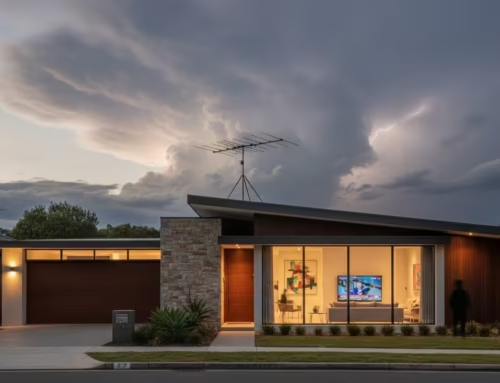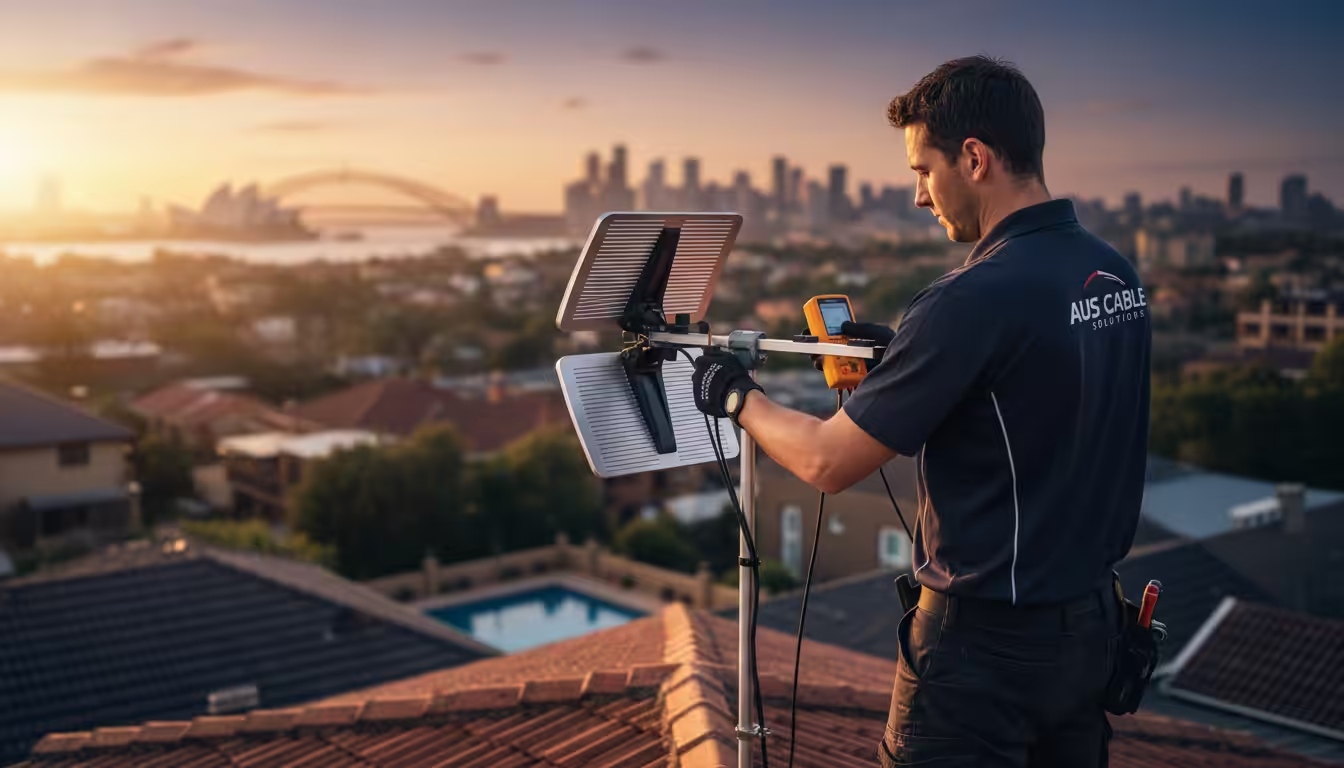
Digital TV installation involves connecting modern television reception equipment designed to receive digitally modulated broadcast signals using UHF antennas, RG6 coaxial cable, and compatible distribution equipment. Unlike older analogue systems that used amplitude modulation and frequency modulation on VHF and UHF bands, digital TV installation requires specific technical standards for signal strength, cabling specifications, and antenna design to deliver error-free reception. The Australian Communications and Media Authority (ACMA) completed the digital television switchover across all Australian regions by December 2013, requiring all households to transition from analogue to digital reception systems. Sydney Cabling has completed over 40,000 digital TV installation jobs across Greater Sydney, working with ACMA-registered cablers who understand the technical requirements that distinguish modern installations from legacy analogue systems.
The differences between digital and analogue systems extend beyond the television itself to encompass antenna design, cable specifications, signal distribution methods, and the licensing requirements mandated under the Australian Communications and Media Authority (ACMA) Cabling Provider Rules 2014. Homeowners upgrading from analogue equipment or purchasing properties with older systems need to understand these technical distinctions to ensure reliable reception and compliance with Australian telecommunications standards.
How Digital Signals Differ From Analogue Transmission
Digital television broadcasts use COFDM (Coded Orthogonal Frequency Division Multiplexing) modulation, which transmits data as discrete packets across multiple carrier frequencies within a single channel. This differs fundamentally from analogue transmission, which used amplitude modulation for video and frequency modulation for audio on single carrier frequencies. The COFDM system includes forward error correction that allows receivers to reconstruct perfect images even when some data packets are corrupted or lost during transmission.
This error correction creates what technicians call the digital cliff effect. Analogue signals degraded gradually as reception conditions worsened, producing progressively more noise and ghosting but remaining watchable. Digital signals maintain perfect picture and sound quality until signal strength drops below a threshold, typically around -65 dBm, at which point reception fails completely. This binary behaviour makes proper digital TV installation critical, as marginal signal levels that would have produced acceptable analogue reception result in complete signal loss with digital systems.
Digital TV signals in Australia use the DVB-T standard operating in the UHF band (channels 6-12 and 28-51), corresponding to frequencies between 174-230 MHz and 520-694 MHz, as allocated by the Australian Communications and Media Authority (ACMA). Sydney metropolitan areas receive signals primarily from transmitters at Artarmon and Gore Hill, with additional fill-in transmitters serving areas with challenging terrain or building obstruction. Understanding how antennas work to receive TV signals helps homeowners appreciate why digital systems require different equipment specifications compared to analogue installations.
The bandwidth efficiency of digital transmission allows multiple standard-definition channels or high-definition channels to occupy the same 7 MHz channel space that carried a single analogue channel. This multiplexing capability means a single antenna pointed at one transmitter location can receive all available free-to-air services, whereas some analogue installations required multiple antennas or complex combining systems to receive channels from different transmitter sites.
Why Digital TV Installation Requires Different Antenna Types (UHF vs VHF)
Analogue television in Australia used both VHF (channels 0-5A and 6-12) and UHF (channels 28-69) frequency bands, requiring different antenna designs optimised for each range. Many older installations used combination VHF/UHF antennas or separate antennas with diplexers to combine signals. Digital television broadcasts exclusively on UHF frequencies in the 520-820 MHz range, making VHF-only antennas obsolete for digital reception.
Digital TV installation typically uses purpose-designed UHF antennas with specific gain characteristics measured in dBi (decibels relative to an isotropic radiator). While some analogue UHF antennas can receive digital signals, modern digital antennas optimise element spacing, reflector design, and impedance matching for the narrower frequency range actually used by digital broadcasters. This optimisation provides higher gain across the relevant frequencies and better rejection of out-of-band interference from mobile phone towers, wireless broadband, and other RF sources that have proliferated since analogue antenna designs were standardised.
By the Numbers
- STATAccording to the Australian Bureau of Statistics, as of 2021, 99% of Australian households had access to digital free-to-air television services, with Sydney metropolitan areas receiving signals from primary transmitters at Artarmon and Gore Hill
- STATThe Australian Communications and Media Authority (ACMA) completed the digital television switchover across all Australian regions by December 2013, requiring all households to transition from analogue to digital reception systems
Antenna gain requirements differ between digital and analogue installations due to the cliff effect behaviour. Analogue systems could function with marginal signal levels, producing snowy pictures that many viewers tolerated. Digital systems require adequate signal strength margins above the minimum threshold to account for weather variations, aircraft flutter, and temporary obstructions. Licensed cablers calculate required antenna gain based on distance from transmitter, terrain shielding, and building materials, typically specifying antennas with 8-15 dBi gain for metropolitan Sydney locations.
The benefits of digital TV antenna installation include improved picture quality, access to additional channels, and electronic program guide functionality, but these advantages require appropriate antenna selection. Homeowners should consult with ACMA-registered cablers about choosing the right TV antenna for Sydney reception conditions rather than attempting to reuse analogue equipment that may not provide adequate performance for digital signals.
Coaxial Cable Requirements: RG6 vs RG59 Standards
Digital TV installation requires RG6 quad-shield coaxial cable as the minimum standard, replacing the RG59 cable commonly used in analogue installations. The technical differences between these cable types directly impact signal quality and system reliability. RG6 cable features a larger centre conductor (typically 18 AWG copper-clad steel compared to 20-22 AWG in RG59), thicker dielectric insulation, and quad-shield construction consisting of aluminium foil, aluminium braid, another foil layer, and outer braid.
This construction provides several advantages critical for digital signals. The 75-ohm impedance matching remains consistent across the UHF frequency range, minimising signal reflections that create standing waves and degrade the modulation error ratio (MER). The quad-shield design provides approximately 90-95 dB of shielding effectiveness against external interference, compared to 60-70 dB for the dual-shield RG59 cable. This additional shielding protects digital signals from mobile phone transmissions, wireless routers, and other RF sources that have become ubiquitous since analogue systems were designed.
Signal attenuation characteristics differ significantly between cable types. At 600 MHz (mid-range for digital TV frequencies), RG6 cable exhibits approximately 5.5 dB loss per 100 metres, while RG59 shows 8-9 dB loss over the same distance. For a typical 20-metre cable run from rooftop antenna to distribution point, this difference amounts to 0.5-0.7 dB, which may seem minor but becomes critical when signal budgets are calculated for multi-outlet installations with splitters and additional cable runs.
For longer cable runs exceeding 30 metres, or installations serving multiple outlets with significant cumulative loss, ACMA-registered cablers may specify RG11 cable. This larger-diameter cable (14 AWG centre conductor) provides approximately 4 dB loss per 100 metres at 600 MHz, preserving signal strength over extended distances. The trade-off involves increased cable stiffness and larger bend radius requirements, making RG11 more challenging to route through wall cavities and roof spaces.
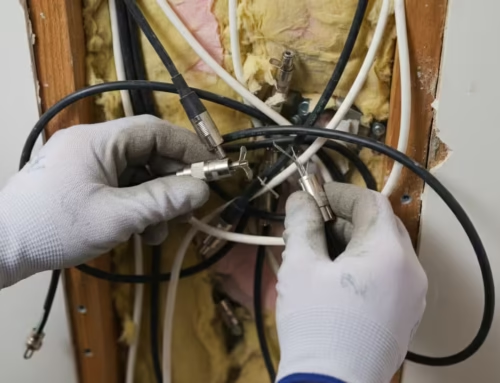
F-type connectors used to terminate coaxial cable must match the cable specification and provide proper impedance continuity. Compression F-connectors have replaced crimp and screw-on types in professional installations, providing consistent 75-ohm impedance and weatherproof seals for outdoor connections. The centre conductor must extend precisely to the connector face without protruding or recessing, as dimensional errors create impedance discontinuities that reflect signals and degrade MER measurements.
Important:
The Installation Process: Digital vs Analogue Setup
The digital TV antenna installation process follows a systematic approach that differs from analogue installations in several key aspects. While both systems require roof access and antenna mounting, digital installations demand more precise antenna alignment, careful attention to cable specifications, and thorough signal measurement at each outlet point.
ACMA-registered cablers begin by conducting a site survey to identify optimal antenna location, assess line-of-sight to transmitter locations, and identify potential interference sources. Digital signals are more susceptible to multipath interference from buildings and terrain features, requiring careful antenna positioning to minimise reflected signal paths that create phase cancellation. The survey includes measuring existing signal levels if upgrading from analogue equipment, documenting cable routes, and planning distribution system layout for multi-room installations.
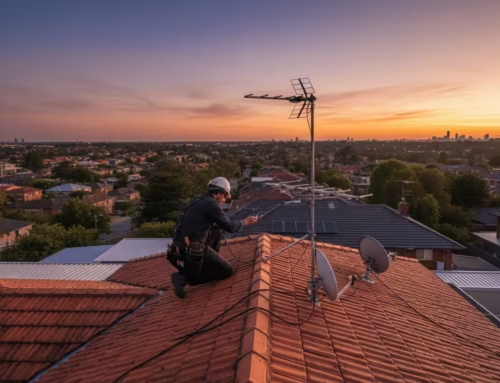
Antenna mounting follows Work Health and Safety Act 2011 (NSW) and Work Health and Safety Regulation 2017 (NSW) requirements for working at heights. Licensed cablers use appropriate fall protection equipment, maintain three points of contact when accessing roofs, and assess roof structural integrity before mounting equipment. Digital antennas typically mount on J-mounts attached to eaves or fascia, or tilt mounts secured to chimney structures, with all mounting hardware rated for wind loading specified in Australian Standards.
Cable installation requires running RG6 quad-shield coaxial cable from the antenna through roof space, down wall cavities or external conduit, to the distribution point or first outlet. Unlike analogue installations where cable quality had less impact on picture quality, digital TV installation demands careful cable routing to avoid sharp bends (minimum bend radius of 10 times cable diameter), separation from electrical wiring to prevent interference, and proper securing to prevent movement that can damage connectors over time.
Connection and termination procedures differ significantly from analogue practices. Each F-connector must be installed with compression tools to ensure consistent impedance and weatherproofing. Outdoor connections receive additional weatherproofing with self-amalgamating tape and heat-shrink tubing. The antenna connection point receives particular attention, as this exposed location experiences temperature cycling, UV exposure, and moisture ingress that can degrade connections and create intermittent faults.
Signal testing concludes the installation process. Licensed cablers measure signal strength in dBm and signal quality using MER measurements at each outlet point, verifying that levels exceed minimum thresholds with adequate margin for environmental variations. Digital tuners in televisions must be rescanned to detect all available channels, and the electronic program guide verified to confirm proper signal decoding. This systematic testing ensures reliable operation rather than the subjective picture quality assessment used for analogue installations.
Signal Measurement: Understanding dBm and dBi in Digital Systems
Digital TV installation requires objective signal measurement using calibrated test equipment, replacing the subjective picture quality assessment used for analogue systems. Two key measurements guide installation decisions: signal strength measured in dBm (decibels relative to one milliwatt) and antenna gain measured in dBi (decibels relative to an isotropic radiator).
Signal strength measurements quantify the RF power level at specific points in the distribution system. Digital television receivers typically require minimum signal levels between -65 dBm and -70 dBm for reliable operation, depending on the receiver’s sensitivity and the broadcast signal’s modulation parameters. Licensed cablers target signal levels between -50 dBm and -30 dBm at wall outlets, providing 15-20 dB margin above the minimum threshold to accommodate weather-related signal variations, seasonal foliage changes, and equipment aging.
Signal levels outside this optimal range create problems. Signals below -65 dBm produce the cliff effect, with intermittent pixelation progressing to complete signal loss. Signals above -20 dBm can overload receiver front-end amplifiers, creating intermodulation distortion that manifests as missing channels or pixelation despite apparently strong signals. This overload condition rarely occurred with analogue systems but frequently affects digital installations in close proximity to transmitters or when excessive distribution amplification is applied.
Antenna gain specifications in dBi indicate how effectively the antenna concentrates received signals compared to a theoretical isotropic radiator that receives equally from all directions. A 10 dBi antenna provides 10 times more signal concentration than an isotropic radiator, translating to 10 dB higher signal strength at the antenna terminals compared to an isotropic reference. Higher gain antennas feature longer boom lengths and more elements, providing better performance for distant transmitters or locations with terrain shielding.
The relationship between antenna gain and signal strength follows the link budget calculation used by ACMA-registered cablers. Starting with the effective radiated power (ERP) from the transmitter, subtracting free-space path loss based on distance and frequency, adding antenna gain, and subtracting cable and connector losses yields the expected signal level at the first receiver or distribution point. This calculation guides antenna selection and identifies when distribution amplifiers are required for multi-outlet installations.
Modulation error ratio (MER) measurements complement signal strength readings by quantifying signal quality. MER compares the received signal constellation to the ideal transmitted constellation, with higher values indicating cleaner signals. Digital television requires minimum MER values of 20-25 dB for reliable operation, with 28-35 dB representing excellent signal quality. MER degradation indicates interference, multipath reception, or amplifier overload even when signal strength appears adequate.
Distribution Amplifiers and Splitters in Digital Installations
Multi-room digital TV installation requires careful signal distribution design to maintain adequate signal levels at each outlet while avoiding overload conditions. Distribution amplifiers and splitters designed for digital signals differ from analogue-era equipment in frequency response, noise figure, and intermodulation performance.
Splitters divide the incoming signal to multiple outputs, with each split introducing insertion loss. A two-way splitter typically introduces 3.5 dB loss to each output, a three-way splitter 5.5 dB, and a four-way splitter 7 dB. These losses are inherent to the power division and cannot be eliminated. Analogue installations often tolerated these losses because picture quality degraded gradually. Digital installations must maintain signal levels above the cliff effect threshold at every outlet, requiring careful calculation of cumulative losses through splitters, cable runs, and connectors.
Distribution amplifiers compensate for splitter and cable losses by boosting signal levels. Digital-grade distribution amplifiers feature low noise figures (typically 3-5 dB) to avoid degrading signal-to-noise ratio, wide dynamic range to handle varying signal strengths across different channels, and high output capability to drive multiple outlets without intermodulation distortion. The amplifier gain must be carefully selected based on the signal budget calculation, as excessive gain creates overload while insufficient gain fails to overcome distribution losses.
Amplifier placement affects system performance significantly. Masthead amplifiers mount at the antenna, amplifying signals before cable losses occur and providing optimal noise performance. Distribution amplifiers install at a central point after the initial cable run, amplifying signals before splitting to multiple outlets. The choice depends on signal strength at the antenna, cable run lengths, and the number of outlets served. Sydney Cabling’s lead technician Fred notes that masthead amplifiers suit weak signal areas or long initial cable runs, while distribution amplifiers work better for strong signal areas with multiple short runs to outlets.
Variable gain controls on distribution amplifiers allow fine-tuning signal levels to each outlet. This adjustment capability proves essential in Sydney installations where some properties receive strong signals from nearby transmitters while others experience terrain shielding or building obstruction. Licensed cablers measure signal levels at each outlet and adjust amplifier gain to maintain the optimal -50 dBm to -30 dBm range, avoiding both weak signal dropout and overload distortion.
Power supply requirements differ between digital and analogue distribution equipment. Modern distribution amplifiers require regulated DC power, typically 12-18V supplied through the coaxial cable using power injectors or via separate power leads. Power injectors must be positioned correctly in the distribution system to avoid blocking signal paths, and backup power options should be considered for installations where television reception serves emergency information needs.
ACMA Licensing Requirements for Digital TV Service Work
The Australian Communications and Media Authority (ACMA) Cabling Provider Rules 2014 establish mandatory licensing requirements for all cabling work connected to telecommunications networks or customer equipment, including digital TV installation. These requirements apply regardless of whether work is performed for commercial purposes or private arrangements, and violations carry significant penalties under the Telecommunications Act 1997 (Cth).
Open Cabler Registration represents the minimum qualification required for digital TV service work. This registration category covers installation, maintenance, and repair of customer cabling including coaxial cable for television reception. Registered cablers must complete accredited training covering technical standards, safety requirements, and regulatory compliance, then pass competency assessments before receiving registration. The Australian Communications and Media Authority (ACMA) maintains a public register of all registered cablers, allowing homeowners to verify credentials before engaging services.
The licensing requirements exist to protect public safety and ensure technical compliance. Improper antenna installation can create fall hazards during maintenance, electrical safety issues if antennas contact power lines, and structural damage if mounting hardware fails during high winds. Incorrect cabling work can introduce interference to other telecommunications services, create fire hazards through improper cable routing near electrical wiring, or result in unreliable reception requiring costly remediation.
Work Health and Safety Act 2011 (NSW) and Work Health and Safety Regulation 2017 (NSW) impose additional obligations on cablers performing antenna installation. These regulations require risk assessments before commencing work at heights, use of appropriate fall protection equipment, and implementation of safe work procedures. Licensed cablers carry public liability insurance covering work-related injuries and property damage, providing protection that unlicensed operators cannot offer.
Sydney Cabling maintains ACMA registration for all technicians performing digital TV installation work, ensuring compliance with the Australian Communications and Media Authority (ACMA) Cabling Provider Rules 2014 and the Telecommunications Act 1997 (Cth). This registration provides homeowners with assurance that work meets technical standards, complies with safety requirements, and qualifies for the up to 20 years warranty on certain parts and labour that Sydney Cabling offers on completed installations.
Homeowners should verify cabler registration before engaging services by checking the ACMA public register or requesting registration documentation. NSW Fair Trading recommends obtaining written quotes specifying the scope of work, equipment specifications, and warranty terms before commencing installation. These precautions protect against unlicensed operators who may offer lower prices but lack the qualifications, insurance, and accountability that registered cablers provide.
When to Upgrade From Analogue to Digital Systems
Homeowners with analogue-era antenna installations should consider upgrading to digital-optimised systems when experiencing reception problems, renovating properties, or noticing any signs your TV antenna needs professional attention. While some older UHF antennas can receive digital signals, purpose-designed digital antennas and modern cabling provide superior performance and reliability.
Pixelation, freezing, or complete signal loss on some channels indicates inadequate signal strength or quality, often resulting from antennas not optimised for digital frequencies or degraded cable connections. Analogue-era installations may use RG59 cable, corroded F-connectors, or distribution amplifiers with insufficient bandwidth for digital signals. These components function adequately for analogue reception but fail to meet digital signal requirements.
Physical antenna damage from weather events, falling branches, or age-related deterioration necessitates replacement rather than repair. Antennas installed before 2010 have likely experienced UV degradation of plastic components, corrosion of aluminium elements, and loosening of hardware connections. When replacement becomes necessary, upgrading to a modern digital-optimised antenna provides better performance than installing another analogue-era design.
Property renovations present ideal opportunities to upgrade antenna systems. Roof repairs, re-roofing, or external painting require temporary antenna removal, making concurrent system upgrades cost-effective. Internal renovations exposing wall cavities allow replacement of old RG59 cable with RG6 quad-shield cable and installation of additional outlets without the access difficulties of retrofit installations.
Adding outlets to serve additional rooms or upgrading to larger televisions may reveal limitations of existing systems. Analogue-era distribution systems often used passive splitters without amplification, producing marginal signal levels that modern digital receivers reject. Upgrading to a properly designed distribution system with appropriate amplification ensures reliable reception at all outlets.
Interference from new mobile phone towers, wireless broadband services, or neighbouring installations can affect older systems lacking adequate cable shielding. Upgrading to RG6 quad-shield cable and digital-grade distribution equipment provides the interference rejection necessary for reliable reception in the increasingly congested RF environment of Sydney metropolitan areas.
Ongoing Maintenance: Digital vs Analogue Requirements
Digital TV installation requires less frequent maintenance than analogue systems due to the binary nature of digital reception, but the consequences of neglected maintenance prove more severe. Analogue systems degraded gradually, providing warning signs of developing problems. Digital systems maintain perfect reception until signal levels drop below threshold, then fail completely without intermediate warning stages.
Regular TV antenna maintenance should include annual visual inspection of antenna physical condition, checking for corroded connections, loose mounting hardware, or damaged elements. These inspections identify developing problems before they cause reception failure. Licensed cablers can perform these inspections during routine maintenance visits, combining visual assessment with signal strength measurements to verify system performance.
Weather events including storms, high winds, and hail can damage antennas or displace antenna alignment. After severe weather, homeowners should arrange professional inspection even if reception appears normal, as minor damage or misalignment may reduce signal margins without immediately causing reception failure. This preventive approach avoids sudden failures during subsequent weather events when signal conditions deteriorate further.
Connector maintenance proves more critical for digital systems than analogue installations. Outdoor F-connectors experience temperature cycling, moisture ingress, and UV exposure that degrade connections over time. Licensed cablers should inspect and re-weatherproof outdoor connections every 3-5 years, replacing connectors showing corrosion or looseness. This preventive maintenance costs significantly less than emergency service calls for failed reception.
Distribution amplifier performance should be verified periodically through signal strength measurements at each outlet. Amplifiers can develop reduced gain or increased noise figure as components age, degrading signal quality below the threshold for reliable digital reception. Amplifier replacement every 10-15 years ensures optimal system performance and avoids the frustration of intermittent reception problems that prove difficult to diagnose.
Changes to broadcast infrastructure occasionally require system adjustments. The Australian Communications and Media Authority (ACMA) periodically reallocates frequency bands or adjusts transmitter parameters, potentially affecting reception at specific locations. Licensed cablers monitor these changes and can advise homeowners when system adjustments or upgrades become necessary to maintain reliable reception.
Frequently Asked Questions
Can I use my old analogue antenna for digital TV in Sydney?
Many older VHF antennas cannot properly receive digital signals, which broadcast primarily on UHF frequencies in Sydney. While some analogue UHF antennas may work, digital TV installation typically requires a purpose-designed antenna optimised for the 520-820 MHz frequency range used by Australian digital broadcasters, as specified by the Australian Communications and Media Authority (ACMA). Modern digital antennas provide higher gain across relevant frequencies and better interference rejection than analogue-era designs. ACMA-registered cablers can assess whether existing antennas meet digital signal requirements or recommend appropriate upgrades for reliable reception from Sydney transmitters at Artarmon and Gore Hill.
Do I need a licensed cabler to install a digital TV antenna?
Yes. Under the Australian Communications and Media Authority (ACMA) Cabling Provider Rules 2014, all coaxial cabling work connected to telecommunications networks or customer equipment must be performed by a registered cabler holding Open Cabler Registration. This applies to digital TV installation work including antenna mounting, coaxial cable runs, and connection to distribution equipment. The Telecommunications Act 1997 (Cth) establishes penalties for unlicensed cabling work, and the Work Health and Safety Act 2011 (NSW) requires proper safety procedures for roof work. Licensed cablers carry appropriate insurance, follow technical standards, and provide warranty coverage that unlicensed operators cannot offer.
What type of cable is required for digital TV installation?
Digital TV installation requires RG6 quad-shield coaxial cable as the minimum standard, which provides 75-ohm impedance and adequate shielding against interference. RG59 cable used in older analogue systems has insufficient bandwidth and shielding for digital signals, exhibiting higher signal loss and greater susceptibility to interference from mobile phones and wireless devices. For longer cable runs exceeding 30 metres, RG11 cable may be specified to minimise signal loss. The quad-shield construction in RG6 cable provides approximately 90-95 dB shielding effectiveness, protecting digital signals from external RF sources that have proliferated since analogue systems were designed.
Why does digital TV either work perfectly or not at all, unlike analogue?
Digital signals use COFDM (Coded Orthogonal Frequency Division Multiplexing) modulation, which includes error correction that maintains perfect picture quality until signal strength drops below a threshold (typically -65 dBm). Below this cliff effect point, the signal fails completely rather than degrading gradually like analogue. Analogue signals used amplitude modulation and frequency modulation that produced progressively more noise and ghosting as reception conditions worsened, but remained watchable at marginal signal levels. This is why proper digital TV installation with adequate signal strength margins proves critical, as marginal signal levels that produced acceptable analogue reception result in complete failure with digital systems.
Can I split a digital TV signal to multiple rooms like I did with analogue?
Yes, but digital TV service requires higher-quality splitters and may need a distribution amplifier to maintain adequate signal levels. Each splitter introduces insertion loss (typically 3.5-7 dB depending on configuration), and digital signals require minimum signal strength at each outlet to avoid the cliff effect. A licensed cabler can calculate signal budgets based on antenna signal strength, cable losses, and splitter losses to determine whether distribution amplification is required. Digital-grade splitters and amplifiers feature wider bandwidth, lower noise figures, and better intermodulation performance than analogue-era equipment, ensuring reliable multi-room reception.
Sydney Cabling has completed over 40,000 digital TV installation jobs across Greater Sydney with 15+ years of experience in modern antenna systems. Our ACMA-registered cablers understand the technical differences between digital and analogue systems and ensure your installation meets current Australian standards with up to 20 years warranty on certain parts and labour.
ACMA licensed. 15+ years experience. Over 40,000 completed jobs across Greater Sydney. Up to 20-year warranty on parts and labour.