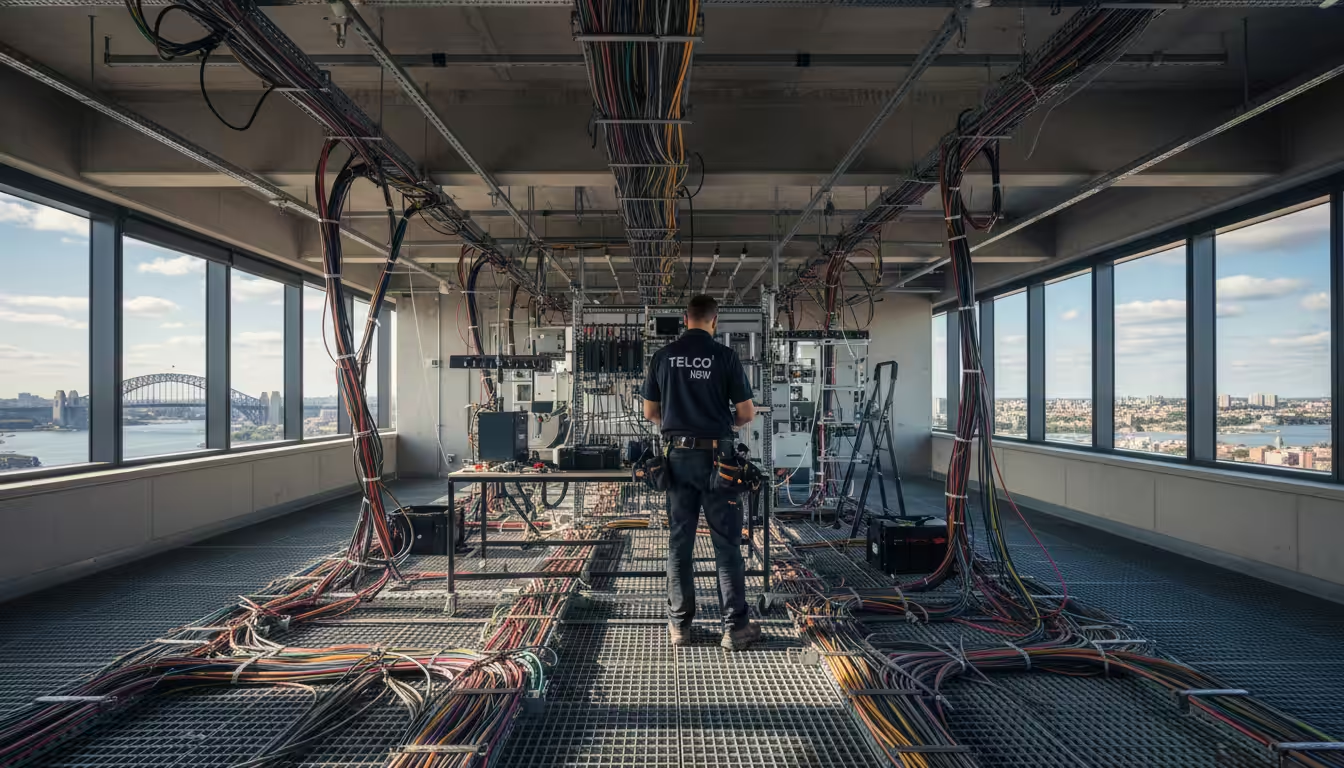
Commercial antenna installation in large buildings presents a fundamentally different set of technical and regulatory challenges compared to residential projects. Property managers and facility managers across Greater Sydney increasingly require robust, scalable signal distribution systems that deliver reliable television reception to dozens or even hundreds of outlets across multiple floors. Sydney Cabling has completed over 40,000 antenna installations in 15+ years, including complex commercial TV antenna installation services in multi-storey buildings throughout Coogee, Vaucluse, St Ives, Lindfield, Manly, Forestville, Killara, Brookvale, Maroubra, Bayview, Dural, Seven Hills, Castle Hill, and surrounding areas. This article examines the specific technical requirements, signal distribution principles, regulatory compliance obligations, and safety considerations that distinguish commercial antenna installation from standard residential work.
Why Commercial Antenna Installation Differs from Residential Projects
The fundamental difference between residential and commercial antenna installation lies in signal distribution complexity. A typical residential installation serves 2-8 television outlets from a single antenna, while commercial buildings may require signal delivery to 50, 100, or more outlets distributed across multiple floors and sometimes multiple buildings. According to the Australian Bureau of Statistics, commercial and industrial buildings account for approximately 18 percent of all cabling work performed in NSW, with antenna and signal distribution systems representing a significant portion of telecommunications infrastructure projects.
Commercial installations must account for substantially longer cable runs, often exceeding 100 metres from the rooftop antenna to the furthest outlet. Each metre of coaxial cable introduces signal loss, measured in decibels (dB), which accumulates across the distribution network. Additionally, commercial systems typically employ multiple splitters to divide the signal among numerous outlets, with each splitter introducing insertion loss that must be compensated through careful system design and strategic amplification.
The regulatory framework also differs significantly. Under the Australian Communications and Media Authority (ACMA) Cabling Provider Rules 2014, all commercial antenna installations must be performed by registered cablers holding Open Cabler Registration, with comprehensive documentation and compliance records maintained for the life of the installation. The Telecommunications Act 1997 (Cth) establishes strict liability for building owners who permit unlicensed cabling work, making contractor verification essential for property managers.
Signal Distribution Challenges in Multi-Storey Buildings
Multi-storey buildings introduce vertical signal distribution challenges that require specialized signal amplification techniques and careful cable routing. According to the Australian Communications and Media Authority (ACMA), over 98 percent of Australian households can access free-to-air digital television, with commercial buildings requiring specialized distribution systems to deliver signals to multiple outlets simultaneously. In Sydney, primary transmitters at Gore Hill and Artarmon provide strong UHF signals to most metropolitan areas, but building structure, height, and surrounding obstructions can significantly affect signal strength at the antenna location.
A typical 10-storey commercial building might require 150 metres of vertical cable run from the rooftop antenna to ground floor outlets, plus horizontal distribution on each floor. Standard RG6 coaxial cable experiences approximately 6-8 dB signal loss per 100 metres at UHF frequencies (470-860 MHz), meaning a 150-metre run could lose 9-12 dB before accounting for splitter insertion loss. When multiple splitters divide the signal across floors and individual outlets, total system loss can easily exceed 30-40 dB, requiring strategic amplification at multiple points in the distribution network.
By the Numbers
- STATCommunications Alliance data shows that signal loss in coaxial cable increases with frequency, with UHF signals (470-860 MHz) experiencing approximately 6-8 dB loss per 100 metres in standard RG6 cable, necessitating distribution amplifiers in large commercial installations.
- STATAccording to ACMA licensing data, only registered cablers holding Open Cabler Registration are legally permitted to install, maintain, or modify commercial antenna systems connected to telecommunications networks, with penalties for non-compliance under the Telecommunications Act 1997 (Cth).
Environmental factors within the building also affect signal distribution. Concrete floors, steel reinforcement, and electrical interference from lift motors, fluorescent lighting, and HVAC systems can degrade signal quality. Fred, Sydney Cabling’s lead technician with over 15 years of commercial installation experience, regularly encounters buildings where electromagnetic interference requires quad-shield coaxial cable and careful cable routing away from high-voltage electrical conduits to maintain acceptable signal-to-noise ratio at every outlet.
Understanding Signal Strength Requirements: dBm, dBi, and Antenna Gain in Commercial Settings
Commercial antenna system design requires precise understanding of signal strength measurements and antenna fundamentals and signal reception principles. Signal strength is measured in dBm (decibels relative to one milliwatt) or dBμV (decibels relative to one microvolt), while antenna gain is expressed in dBi (decibels relative to an isotropic radiator). A typical UHF antenna for commercial installation might provide 10-15 dBi gain, effectively amplifying the received signal before it enters the distribution system.
Digital television tuners require minimum signal strength of approximately 50-55 dBμV for reliable reception, with optimal performance occurring between 60-75 dBμV. Signal levels below 50 dBμV result in pixelation, audio dropouts, and complete loss of picture, while excessive signal strength above 80 dBμV can overload tuners and cause similar reception problems. Commercial system design must ensure every outlet receives signal within this optimal range, regardless of its distance from the antenna or position in the distribution network.
Calculating total system gain and loss requires accounting for every component in the signal path. If the antenna receives -30 dBm signal from the transmitter and provides 12 dBi gain, the signal entering the distribution system starts at approximately -18 dBm (equivalent to about 70 dBμV). A 100-metre RG6 cable run loses 7 dB, an 8-way splitter introduces 12 dB insertion loss, and additional cable to individual outlets adds another 3-5 dB. Total loss of 22-24 dB reduces signal to 46-48 dBμV at the outlet, below the minimum threshold for reliable reception. This calculation demonstrates why commercial installations require distribution amplifiers to compensate for cumulative signal loss.
Coaxial Cable Selection: RG6 vs RG11 for Long Cable Runs
Coaxial cable specification represents a critical decision in commercial antenna system design. RG6 cable, standard for most residential installations, features 18 AWG center conductor and approximately 6.8 mm outer diameter. RG11 cable uses a larger 14 AWG center conductor and 10.3 mm outer diameter, resulting in significantly lower signal loss per metre. At UHF frequencies, RG6 loses approximately 6-8 dB per 100 metres, while RG11 loses only 4-5 dB over the same distance.
For commercial buildings with vertical cable runs exceeding 50 metres, RG11 cable often proves more cost-effective than RG6 despite higher material costs. The reduced signal loss minimizes amplification requirements, simplifies system design, and improves long-term reliability. A 150-metre RG6 run loses approximately 10-12 dB, while the same length of RG11 loses only 6-7.5 dB, a difference of 4-5 dB that can eliminate the need for an additional line amplifier.
Cable shielding also affects performance in commercial environments. Standard dual-shield RG6 provides adequate protection in most residential settings, but commercial buildings with significant electromagnetic interference benefit from quad-shield cable featuring two layers of foil and two layers of braided copper shielding. This additional shielding prevents interference from lift motors, fluorescent ballasts, and other electrical equipment that can degrade signal quality and introduce noise into the distribution system.
Distribution Amplifiers, Splitters, and Signal Loss Management
Distribution amplifiers form the core of commercial antenna systems, compensating for signal loss across long cable runs and multiple splitters. A typical commercial installation employs a high-gain distribution amplifier (20-30 dB gain) at the headend, immediately after the antenna, to boost signal before distribution. For buildings exceeding 5-6 floors, additional line amplifiers may be required every 3-4 floors to maintain adequate signal strength throughout the vertical distribution network.
Amplifier placement requires careful calculation to avoid over-amplification, which causes signal distortion and reception problems as severe as under-amplification. Each amplifier should boost signal to approximately 75-80 dBμV at its output, accounting for losses in downstream cable and splitters to deliver 60-70 dBμV at the furthest outlet. Multiple amplifiers in series must be carefully configured to prevent cumulative gain that drives signal levels above 85 dBμV, the threshold where most digital tuners experience overload and pixelation.
Splitter selection and configuration significantly impact system performance. An 8-way splitter introduces approximately 12 dB insertion loss, while a 4-way splitter loses about 7 dB and a 2-way splitter only 3.5 dB. Commercial systems often employ cascaded splitters rather than single high-count splitters to minimize loss on critical paths. For example, a 2-way splitter might divide signal between two wings of a building, with 4-way splitters on each wing serving individual floors, resulting in lower cumulative loss than a single 8-way splitter serving all outlets directly.
- 1 Measure Signal Strength at Antenna LocationUsing a calibrated digital signal meter, measure received signal strength from primary transmitters (Gore Hill, Artarmon) to establish baseline input level for system design calculations.
- 2 Calculate Total System LossAccount for cable loss (6-8 dB per 100m RG6, 4-5 dB per 100m RG11), splitter insertion loss (3.5-12 dB depending on configuration), and F-type connector loss (0.5 dB per connection) across all signal paths.
- 3 Specify Distribution Amplifier GainSelect amplifier gain to compensate for total system loss while maintaining 60-75 dBμV at all outlets, avoiding over-amplification that causes tuner overload and signal distortion.
- 4 Position Line Amplifiers StrategicallyFor multi-storey buildings, install line amplifiers every 3-4 floors to maintain signal strength throughout vertical distribution, ensuring adequate level at ground floor outlets furthest from the rooftop antenna.
- 5 Verify Signal Quality at Every OutletPost-installation testing with digital signal meter confirms signal strength, Modulation Error Ratio (MER), and bit error rate meet Australian digital television standards at all outlet locations.
Regulatory Compliance and Licensing: ACMA Cabling Provider Rules 2014
Commercial antenna installation falls under strict regulatory oversight established by the Telecommunications Act 1997 (Cth) and enforced through the Australian Communications and Media Authority (ACMA) Cabling Provider Rules 2014. These regulations mandate that all cabling work connected to telecommunications networks, including antenna and coaxial distribution systems, must be performed by registered cablers holding appropriate registration categories. For commercial antenna systems, this requires Open Cabler Registration, the highest level of ACMA cabling registration.
Important:
The ACMA Cabling Provider Rules 2014 establish comprehensive compliance requirements for commercial cabling installations, including mandatory documentation, testing, and record-keeping obligations. Registered cablers must provide compliance certificates for all completed work, maintain detailed records of cable routes and equipment specifications, and ensure all installations meet Australian Standards for telecommunications cabling. Property managers should verify contractor registration through the ACMA Cabling Provider Register before authorizing any commercial antenna work.
NSW Fair Trading enforces additional consumer protection requirements for commercial cabling contracts, including written quotations, detailed scope of work documentation, and specified warranty periods. Sydney Cabling provides up to 20 years warranty on certain parts and labour for commercial antenna installations, significantly exceeding minimum statutory requirements and reflecting our confidence in system design and installation quality developed through 15+ years of commercial project experience.
Workplace Safety Requirements Under Work Health and Safety Act 2011 (NSW)
Commercial antenna installation on multi-storey buildings involves significant workplace safety risks governed by the Work Health and Safety Act 2011 (NSW) and Work Health and Safety Regulation 2017 (NSW). These regulations establish comprehensive safety obligations for both contractors and building owners, including mandatory fall protection systems, Working at Heights certification for all personnel, and detailed risk assessment documentation before commencing rooftop work.
The Work Health and Safety Regulation 2017 (NSW) specifically addresses high-risk construction work, including any work performed at heights exceeding 2 metres. Commercial antenna installation typically occurs at substantially greater heights, requiring full fall protection systems including edge protection barriers, safety harnesses, and certified anchor points. Licensed cablers must hold current Working at Heights certification and demonstrate competency in fall protection equipment use, emergency procedures, and hazard identification.
- ✓
Verify all contractors hold current Working at Heights certification and provide evidence of competency before authorizing rooftop access - ✓
Confirm that certified anchor points and fall protection systems are installed and load-tested in accordance with AS/NZS 1891 standards - ✓
Require contractors to provide Safe Work Method Statements (SWMS) addressing specific hazards of your building before work commences - ✓
Ensure contractors maintain minimum $20 million public liability insurance covering high-risk construction work and property damage - ✓
Document all safety equipment inspections, anchor point certifications, and contractor qualifications for compliance records
Building owners and property managers share legal responsibility for workplace safety under the Work Health and Safety Act 2011 (NSW), including obligations to provide safe access, maintain fall protection systems, and ensure contractors comply with safety regulations. Failure to meet these obligations can result in significant penalties under NSW workplace safety legislation, as well as liability for injuries or property damage resulting from inadequate safety measures.
Troubleshooting Common Commercial Installation Issues
Commercial antenna systems present unique troubleshooting challenges due to their complexity and scale. Understanding common antenna system issues helps property managers identify problems early and minimize disruption to building occupants. The most frequent commercial installation problems include inadequate signal strength at distant outlets, amplifier overload causing pixelation, interference from building electrical systems, and signal quality degradation over time.
Inadequate signal strength typically manifests as pixelation, audio dropouts, or complete loss of picture on specific channels, particularly during adverse weather conditions. This usually indicates insufficient amplification to compensate for cable and splitter losses, or degraded cable connections introducing additional signal loss. Systematic signal strength measurement at distribution amplifiers, splitters, and problem outlets identifies the specific point where signal falls below the 50-55 dBμV minimum threshold for reliable digital television reception.
Amplifier overload produces similar symptoms but results from excessive signal strength rather than insufficient level. When signal exceeds 80-85 dBμV, digital tuners experience overload distortion that causes pixelation and reception problems identical to weak signal conditions. Overload typically affects all outlets simultaneously, while weak signal problems usually impact only the furthest or highest-loss outlets in the distribution network. Measuring signal strength at affected outlets immediately distinguishes between these two opposite causes of similar symptoms.
Electromagnetic interference from building systems represents a particularly challenging commercial installation problem. Lift motors, fluorescent lighting ballasts, variable-frequency drives, and switching power supplies generate broadband electrical noise that can couple into coaxial distribution systems through inadequate cable shielding or poor grounding. Interference typically manifests as intermittent pixelation or audio dropouts correlated with specific building equipment operation, such as lift movement or lighting activation. Quad-shield coaxial cable, proper cable routing away from electrical conduits, and comprehensive system grounding minimize interference susceptibility.
Maintenance and Future-Proofing Your Commercial Antenna System
Commercial antenna systems require ongoing antenna maintenance programs to ensure reliable long-term performance across dozens or hundreds of outlets. Unlike residential installations where homeowners immediately notice reception problems, commercial systems may develop localized issues affecting only specific floors or zones that go unreported for extended periods. Scheduled maintenance identifies developing problems before they cause widespread service disruption.
A comprehensive commercial antenna maintenance program includes annual rooftop antenna inspection for physical damage, corrosion, or mounting hardware deterioration, distribution amplifier testing to verify gain and noise figure remain within specifications, and systematic signal strength measurement at representative outlets throughout the building. Fred regularly conducts preventive maintenance inspections for commercial clients across Greater Sydney, identifying issues such as corroded F-type connectors, moisture ingress in outdoor enclosures, and degraded splitter performance before they cause service failures.
Future-proofing commercial antenna systems involves designing infrastructure to accommodate evolving broadcast standards and building expansion. While current free-to-air digital television uses UHF frequencies between 520-820 MHz in Sydney, future spectrum reallocation or additional services may require system modifications. Installing oversized conduits during initial construction, providing spare capacity in distribution amplifiers, and documenting complete system specifications facilitates future upgrades without requiring extensive cable replacement or building disruption.
Integration with other building systems also represents an important future-proofing consideration. Many commercial buildings now combine free-to-air television distribution with Foxtel satellite services, IPTV systems, and structured data cabling. Using diplexers to combine multiple signal types onto common coaxial infrastructure, or installing hybrid fiber-coaxial systems that support both traditional RF distribution and IP-based video delivery, provides flexibility for future service additions without requiring complete system replacement.
Choosing the Right Installation Partner for Large-Scale Projects
Selecting a qualified contractor for commercial antenna installation requires careful evaluation of technical capability, regulatory compliance, and project management experience. Property managers should prioritize contractors demonstrating comprehensive understanding of signal distribution principles, proven experience with multi-storey installations, and full ACMA Open Cabler Registration. The process of selecting qualified antenna technicians for commercial projects differs significantly from residential contractor selection.
Verification of ACMA registration through the official Cabling Provider Register represents the essential first step in contractor evaluation. This public database confirms registration status, registration categories held, and any disciplinary actions or compliance issues. Only contractors holding Open Cabler Registration are legally permitted to perform commercial antenna installations under the Australian Communications and Media Authority (ACMA) Cabling Provider Rules 2014, and property managers should reject any contractor unable to provide current registration evidence.
Project-specific experience and technical capability assessment should include review of similar completed projects, understanding of signal strength calculations and distribution system design, and ability to provide comprehensive documentation including system diagrams, equipment specifications, and compliance certificates. Contractors should demonstrate familiarity with relevant Australian Standards, building code requirements, and integration with existing building management systems.
- ✓
Conduct comprehensive site survey to assess signal strength from local transmitters and identify potential interference sources - ✓
Calculate total signal loss across all cable runs, splitters, and distribution points to determine required amplifier gain measured in dB - ✓
Verify that all cablers hold current ACMA Open Cabler Registration and provide proof of public liability insurance before commencing work - ✓
Ensure rooftop access, fall protection systems, and safety equipment comply with Work Health and Safety Regulation 2017 (NSW) requirements - ✓
Specify appropriate coaxial cable type (RG6 for runs under 50m, RG11 for longer distances) and quad-shield cable for high-interference environments - ✓
Plan distribution amplifier placement to maintain signal levels between 60-75 dBμV at all outlets, avoiding over-amplification that causes pixelation - ✓
Document all cable routes, amplifier locations, and outlet positions for future maintenance and compliance records - ✓
Schedule post-installation testing with digital signal meter to verify signal strength, bit error rate, and picture quality at every outlet
Warranty provisions and ongoing support capabilities represent critical selection criteria for commercial projects. Extended warranty coverage on both parts and labour provides protection against premature equipment failure and installation defects, while responsive maintenance and troubleshooting support minimizes service disruption when problems occur. Property managers should prioritize contractors offering comprehensive warranty coverage and documented maintenance programs tailored to commercial installation requirements.
Sydney Cabling has completed over 40,000 antenna installations across Greater Sydney in 15+ years, including complex commercial projects in multi-storey buildings. Our ACMA-registered cablers deliver compliant, scalable signal distribution solutions backed by up to 20 years warranty on certain parts and labour. Contact us today for a comprehensive site assessment and detailed project quote.
ACMA licensed. 15+ years experience. Over 40,000 completed jobs across Greater Sydney. Up to 20-year warranty on parts and labour.
Frequently Asked Questions
Do I need a licensed cabler for commercial antenna installation in Sydney?
Yes. Under the Australian Communications and Media Authority (ACMA) Cabling Provider Rules 2014, all commercial antenna installations must be performed by a registered cabler holding Open Cabler Registration. This ensures compliance with the Telecommunications Act 1997 (Cth) and protects building owners from liability. Sydney Cabling holds full ACMA registration for structured, coaxial, and optical fibre cabling work.
How many distribution amplifiers do I need for a 10-storey commercial building?
This depends on signal strength at the antenna, cable run lengths, and the number of outlets. A typical 10-storey building requires at least one high-gain distribution amplifier (20-30 dB gain) at the headend, with possible line amplifiers every 3-4 floors to compensate for signal loss in RG6 or RG11 coaxial cable. A qualified cabler will conduct a site survey and signal strength assessment to determine exact requirements.
What’s the difference between RG6 and RG11 cable for commercial installations?
RG11 coaxial cable has lower signal loss per metre than RG6, making it preferable for long cable runs in large buildings. RG6 loses approximately 6-8 dB per 100 metres at UHF frequencies, while RG11 loses only 4-5 dB. For runs exceeding 50 metres or multi-floor distribution, RG11 reduces the need for additional amplification and delivers more reliable signal quality.
Can I use the same antenna system for both free-to-air TV and Foxtel in a commercial building?
Yes, using a diplexer or combiner system. Free-to-air digital TV uses UHF frequencies (typically 520-820 MHz in Sydney), while Foxtel satellite signals operate at different frequencies. A properly designed commercial system can combine both signals onto a single coaxial distribution network, but this requires careful planning by a licensed cabler to prevent interference and maintain signal quality across all outlets.
What workplace safety requirements apply to commercial antenna installation on rooftops?
Under the Work Health and Safety Act 2011 (NSW) and Work Health and Safety Regulation 2017 (NSW), all rooftop antenna work requires fall protection measures, including edge protection, safety harnesses, and anchor points. Licensed cablers must hold Working at Heights certification and conduct risk assessments before commencing work. Property managers are responsible for ensuring contractors comply with these requirements.