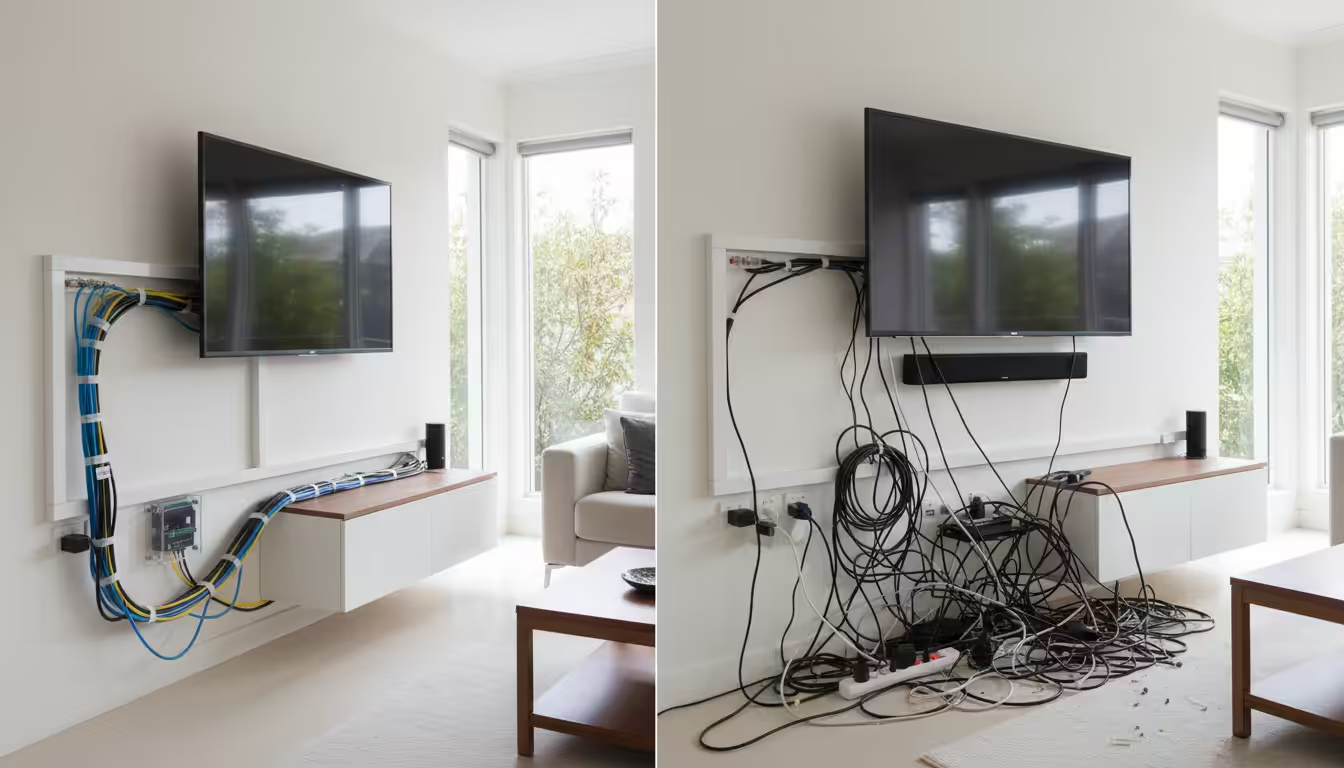
When planning a TV cabling installation for your Sydney home, the choice between structured cabling and basic wiring affects signal quality, future scalability, and long-term costs. Structured TV cabling uses a centralised distribution system with amplifiers and star topology to deliver consistent signal strength to multiple outlets, while basic wiring relies on point-to-point connections with passive splitters. Understanding the technical and regulatory differences helps homeowners make informed decisions about which system suits their property’s layout and viewing requirements.
According to the Australian Communications and Media Authority (ACMA), over 5.2 million Australian households rely on free-to-air digital television as their primary viewing source as of 2023. The Australian Bureau of Statistics (ABS) reports that 89% of Sydney households have multiple television sets, creating demand for multi-point distribution systems. Both structured and basic TV cabling installations must comply with the Telecommunications Act 1997 (Cth) and be performed by registered cablers under the Australian Communications and Media Authority (ACMA) Cabling Provider Rules 2014.
What Is Structured TV Cabling?
Structured TV cabling establishes a centralised distribution point where incoming antenna or satellite signals are amplified and distributed through dedicated RG6 coaxial cables to individual wall plates throughout the property. This star topology design runs separate cables from a central distribution amplifier to each TV outlet, eliminating the cumulative signal loss that occurs with daisy-chained connections. The distribution amplifier typically provides 10-20 dBi gain to maintain signal strength across all outlets, ensuring each TV point receives adequate signal levels between -40 and -50 dBm as specified by Communications Alliance standards.
A properly designed structured system incorporates F-type connectors at all termination points, wall plates in each room requiring TV access, and a distribution amplifier sized according to the number of outlets and cable run lengths. Sydney Cabling has completed over 40,000 installations across Greater Sydney, with structured cabling becoming the preferred solution for properties with three or more TV locations. This approach supports structured cabling for future-proofing your Sydney home by accommodating additional outlets without signal degradation.
The centralised distribution point also allows integration of multiple signal sources through diplexers or multiswitches, combining UHF free-to-air signals with satellite feeds from a single location. This eliminates the need for separate cable runs for different services and simplifies troubleshooting when signal issues arise, as all connections can be inspected and tested at the central distribution point rather than tracing multiple cable paths throughout the property.
What Is Basic TV Wiring?
Basic TV wiring uses a simpler point-to-point approach where coaxial cable runs from the antenna directly to the primary TV location, with additional outlets added through passive splitters that divide the signal without amplification. Each splitter introduces insertion loss ranging from 3.5 dB for a two-way split to 7 dB or more for four-way splits, progressively weakening the signal at downstream TV points. This topology works adequately for single TV installations or properties in strong signal areas where the incoming antenna signal exceeds -40 dBm with sufficient margin to accommodate splitter losses.
Basic wiring typically employs RG6 coaxial cable for the main run from the antenna, though some older installations may use lower-grade RG59 cable that exhibits higher signal loss and inferior shielding. The simplicity of basic wiring reduces initial installation costs and works well for apartments or small homes with one or two TV locations in close proximity to the antenna connection point. However, this approach offers limited scalability, as adding additional TV outlets requires either accepting further signal degradation through additional splitters or upgrading to a structured system with amplification.
Properties in Sydney’s fringe reception areas including parts of the Northern Beaches, Hills District, and outer Western suburbs often experience marginal signal levels where basic wiring with passive splitters results in pixelation, dropouts, or complete signal loss on secondary TV outlets. In these locations, even a two-way split can reduce signal strength below the minimum -70 dBm threshold required for reliable digital TV reception, particularly during weather events that affect signal propagation.
Signal Distribution and Quality Differences
The fundamental difference between structured cabling and basic wiring lies in how each system manages signal strength across multiple outlets. Structured systems use active amplification to compensate for cable loss and maintain consistent signal levels at every TV point, while basic wiring relies on passive splitting that progressively weakens the signal with each additional outlet. Communications Alliance standards specify that residential coaxial cabling installations must maintain signal levels between -40 and -70 dBm for reliable digital TV reception, a requirement that becomes increasingly difficult to meet with basic wiring as the number of TV outlets increases.
Signal quality measurements including Modulation Error Ratio (MER) typically remain more stable across structured cabling systems because the distribution amplifier provides consistent gain to all outlets. Basic wiring with multiple passive splits often shows degraded MER values at distant TV points, particularly when cable runs exceed 20 metres or pass through areas with electromagnetic interference from electrical wiring or appliances. Understanding digital TV antenna installation benefits helps homeowners recognise that proper antenna selection and positioning must be matched with appropriate cabling infrastructure to deliver optimal signal quality throughout the property.
Distribution amplifiers in structured systems also provide isolation between outlets, preventing signal reflections or impedance mismatches at one TV location from affecting other outlets. Basic wiring with passive splitters offers no such isolation, meaning a poorly terminated connection or faulty TV tuner at one outlet can introduce standing waves or signal degradation that affects all downstream TV points on the same cable run. This isolation characteristic makes structured cabling particularly valuable in strata properties or homes where different family members may connect various devices to TV outlets without coordinating equipment specifications.
By the Numbers
- STATAccording to the Australian Communications and Media Authority (ACMA), over 5.2 million Australian households rely on free-to-air digital television as their primary viewing source as of 2023
- STATThe Australian Bureau of Statistics (ABS) reports that 89% of Sydney households have multiple television sets, creating demand for multi-point distribution systems
- STATCommunications Alliance standards specify that residential coaxial cabling installations must maintain signal levels between -40 and -70 dBm for reliable digital TV reception
Cable Types and Technical Specifications
Both structured and basic TV cabling systems use 75-ohm coaxial cable to maintain proper impedance matching with antenna systems and TV tuners, though the specific cable type affects signal loss and shielding performance. RG6 quad-shield coaxial cable has become the Australian standard for residential TV installations, offering four layers of shielding that provide superior protection against electromagnetic interference from electrical wiring, mobile phone signals, and other RF sources. This cable type exhibits approximately 2.5 dB signal loss per 30 metres at UHF frequencies, making it suitable for most residential cable runs under 50 metres in length.
RG11 coaxial cable provides lower signal loss at approximately 1.5 dB per 30 metres and is specified for longer cable runs exceeding 30 metres or commercial installations where minimising signal degradation is critical. The larger diameter of RG11 cable makes it more difficult to route through wall cavities and requires larger radius bends, limiting its use in residential structured cabling to main trunk runs from antenna to distribution amplifier. Understanding how antennas help with TV reception clarifies why proper cable selection matters, as even the best antenna installation delivers poor results if cable losses degrade the signal before it reaches TV tuners.
F-type connectors provide the standard termination method for both RG6 and RG11 cables, using compression or crimp attachment methods to ensure consistent 75-ohm impedance and weatherproof sealing at outdoor connections. Structured cabling installations typically use compression F-type connectors throughout for superior reliability and lower insertion loss compared to screw-on connectors sometimes used in basic wiring. Wall plates with integrated F-type sockets provide clean termination points in each room, eliminating exposed cable ends that can accumulate dust or suffer mechanical damage from repeated connection and disconnection of fly leads.
Licensing and Compliance Requirements Under ACMA Cabling Provider Rules
The Australian Communications and Media Authority (ACMA) Cabling Provider Rules 2014 establish mandatory registration requirements for anyone performing fixed coaxial cabling work that connects to telecommunications networks or distribution systems. Both structured TV cabling and basic wiring installations fall under these regulations, meaning all in-wall cabling, distribution amplifier installation, wall plate termination, and antenna mounting must be performed by cablers holding current ACMA Open Cabler Registration. Sydney Cabling maintains full ACMA registration and Open Cabler Registration, ensuring all TV cabling installation work complies with the Telecommunications Act 1997 (Cth) and associated technical standards.
The distinction between licensed cabler work and homeowner-permissible tasks is clearly defined under the regulations. Homeowners can connect fly leads between wall plates and TV devices, replace damaged fly leads, and move TVs between existing wall plate outlets without requiring a registered cabler. However, any work involving fixed cabling installation, modification of distribution systems, or connection of new outlets requires professional installation by a licensed cabler. This regulatory framework protects homeowners from substandard installations that could cause signal interference, create fire hazards through improper cable routing near electrical wiring, or violate building codes. Further detail on compliance requirements for cabling installations demonstrates how these standards apply across residential and commercial properties.
NSW Fair Trading provides consumer protection oversight for cabling services, requiring licensed cablers to provide written quotes, maintain appropriate insurance, and offer warranty coverage on workmanship. Sydney Cabling provides up to 20 years warranty on certain parts and labour for TV cabling installations, reflecting the quality of materials and installation techniques used across our 40,000 completed jobs. This warranty coverage applies to both structured cabling systems and basic wiring installations, though the longer service life and reduced maintenance requirements of structured systems often make them more cost-effective over the warranty period.
Important:
Installation Complexity and Cost Considerations
Structured TV cabling requires more extensive planning and installation work compared to basic wiring, affecting both project timeline and upfront costs. A typical structured installation involves site assessment to determine optimal distribution amplifier location, cable pathway planning to route RG6 cables through wall cavities or roof spaces to each TV outlet location, installation and configuration of the distribution amplifier with appropriate gain settings, termination of all cables with F-type connectors and wall plates, and signal level testing at each outlet to verify compliance with Communications Alliance standards. This process typically takes one to two days for a standard residential property with four to six TV outlets, depending on building construction and accessibility of cable pathways.
Basic wiring installations proceed more quickly for single or dual TV setups, often completed within a few hours when cable pathways are straightforward and the primary TV location is close to the antenna connection point. However, basic wiring becomes progressively more complex and time-consuming as additional TV outlets are added through passive splitters, requiring careful signal level calculations to ensure adequate signal strength at all locations. Properties in marginal signal areas may discover during installation that basic wiring cannot support the desired number of TV outlets without signal degradation, necessitating an upgrade to structured cabling with amplification. The benefits of professional data cabling installation parallel those of structured TV cabling, as both systems benefit from proper planning and professional installation techniques.
Cost differences between structured and basic TV cabling reflect the additional materials and labour involved in structured installations. Distribution amplifiers typically cost between 200 and 600 dollars depending on the number of outputs and gain specifications, while RG6 cable, F-type connectors, and wall plates add material costs proportional to the number of TV outlets. Labour costs for structured installations are higher due to the additional time required for system design, amplifier configuration, and comprehensive signal testing. However, structured cabling eliminates future rewiring costs when adding TV outlets or upgrading to new services, making it more cost-effective over the typical 15 to 20 year service life of a residential TV cabling system.
Scalability and Future-Proofing
Structured TV cabling systems offer superior scalability compared to basic wiring, accommodating additional TV outlets without signal degradation or system redesign. The star topology used in structured installations allows new outlets to be added by running additional RG6 cables from the central distribution amplifier to new wall plate locations, with the amplifier’s gain specifications selected during initial installation to support the maximum anticipated number of outlets. This forward planning approach means homeowners can add TV outlets in bedrooms, outdoor entertainment areas, or home theatres without affecting signal quality at existing locations or requiring replacement of the distribution system.
Basic wiring systems have limited scalability because each additional TV outlet requires either accepting further signal loss through additional passive splits or upgrading to an amplified distribution system. Properties initially installed with basic wiring often require complete system replacement when homeowners add multiple TV outlets during renovations, as the cumulative signal loss from multiple splitters exceeds acceptable levels. This replacement cost typically exceeds the incremental expense of installing structured cabling during initial construction or renovation, making structured systems more economical for properties where future TV outlet additions are likely. Strategies to future-proof your home with smart cabling solutions emphasise the long-term value of investing in proper infrastructure during initial installation.
The centralised distribution point in structured systems also simplifies integration of new signal sources or technologies as they become available. Adding satellite services, upgrading to higher-gain antennas for improved reception, or incorporating signal distribution for streaming devices can be accomplished at the central distribution amplifier without modifying cabling throughout the property. This flexibility proves particularly valuable in Sydney’s evolving broadcast environment, where changes to transmission frequencies or the introduction of new services may require antenna upgrades that benefit from the adaptability of structured cabling infrastructure.
Which System Is Right for Your Sydney Home?
The choice between structured TV cabling and basic wiring depends on several property-specific factors including the number of TV outlets required, signal strength in your location, building construction characteristics, and long-term plans for the property. Structured cabling represents the optimal solution for properties with three or more TV outlets, homes in Sydney’s fringe reception areas including parts of the Northern Beaches, Hills District, Sutherland Shire, and outer Western suburbs, properties undergoing renovation where cable pathways are accessible, and homes where future TV outlet additions are anticipated. The consistent signal quality and scalability of structured systems justify the higher initial investment for these applications.
Basic wiring remains appropriate for apartments or small homes with one or two TV outlets in close proximity, properties in strong signal areas near transmission towers where incoming signal levels exceed -40 dBm with adequate margin, temporary installations where long-term system performance is not a priority, and budget-constrained projects where the property will not require additional TV outlets. However, even in these scenarios, consulting with an experienced cabler helps determine whether the modest cost difference between basic and structured installations justifies the long-term benefits of a properly designed distribution system.
Sydney Cabling’s lead technician Fred conducts site assessments that include signal strength measurements at the antenna location, evaluation of cable pathway options through the property, calculation of expected signal levels at each proposed TV outlet location, and recommendations for distribution system specifications matched to your viewing requirements. This assessment process ensures the selected TV cabling approach delivers reliable signal quality while avoiding over-specification that increases costs without corresponding performance benefits. Our 15 years of experience across Greater Sydney provides the technical knowledge to recommend the most appropriate solution for your specific property characteristics and signal environment.
Why Licensed TV Cable Installers Matter
Professional TV cabling installation by licensed cablers ensures compliance with the Australian Communications and Media Authority (ACMA) Cabling Provider Rules 2014, proper signal level management according to Communications Alliance standards, and safe installation practices that meet the Work Health and Safety Act 2011 (NSW) requirements for working at heights and in roof spaces. Licensed cablers possess the test equipment necessary to measure signal strength in dBm, verify impedance matching across the distribution system, and identify sources of interference that affect signal quality. This technical capability prevents common installation errors including inadequate amplifier gain settings, improper cable termination that causes signal reflections, and cable routing near electrical wiring that introduces noise into the TV signal.
Sydney Cabling’s ACMA-registered cablers bring 15 years of experience to every TV cabling installation, understanding how Sydney’s varied terrain and building construction affects signal distribution requirements. Properties in coastal suburbs face different challenges from homes in the Hills District or Western Sydney, with factors including distance from transmission towers, terrain shielding, and building materials all affecting optimal cabling system design. Our experience across 40,000 completed jobs provides the knowledge base to anticipate site-specific challenges and design TV cabling systems that deliver reliable performance across Sydney’s diverse signal environments.
Licensed installation also provides warranty protection and recourse through NSW Fair Trading if issues arise with workmanship or materials. Sydney Cabling’s warranty of up to 20 years on certain parts and labour reflects our confidence in the quality of materials specified and installation techniques employed. This warranty coverage includes both the physical cabling infrastructure and the distribution amplifiers or other active components, providing long-term protection that DIY installations or unlicensed work cannot offer. When searching for TV cable installers near me, verification of current ACMA registration and appropriate insurance coverage protects homeowners from liability for injuries or property damage that may occur during installation work.
Frequently Asked Questions
Can I install my own TV cabling or do I need a licensed cabler?
Under the Australian Communications and Media Authority (ACMA) Cabling Provider Rules 2014, all fixed coaxial cabling work connecting to telecommunications networks or distribution systems must be performed by a registered cabler. Homeowners can connect fly leads between wall plates and devices, but in-wall cabling and distribution amplifier installation require ACMA registration. Attempting DIY TV cabling installation may void home insurance, violate strata bylaws in apartment buildings, and result in signal quality issues requiring complete reinstallation by a licensed professional. The Telecommunications Act 1997 (Cth) establishes these requirements to ensure cabling work meets technical standards and does not cause interference to other telecommunications services.
What type of coaxial cable is best for digital TV in Sydney?
RG6 quad-shield coaxial cable is the Australian standard for digital TV installations, offering 75-ohm impedance and superior shielding against interference. For longer cable runs exceeding 30 metres or commercial installations, RG11 cable provides lower signal loss at 1.5 dB per 30 metres compared to RG6’s 2.5 dB per 30 metres. The quad-shield construction includes two layers of foil shielding and two layers of braided shielding, providing protection against electromagnetic interference from mobile phone signals, electrical wiring, and other RF sources common in Sydney’s urban environment. Older RG59 cable should be replaced during TV cabling installation upgrades as it exhibits higher signal loss and inadequate shielding for modern digital TV signals.
How much does structured TV cabling installation cost in Sydney?
Structured TV cabling installation typically costs more upfront than basic wiring due to centralised distribution systems, quality RG6 cabling throughout, and professional design. However, it eliminates future rewiring costs and supports multiple TV points with consistent signal strength, making it more cost-effective long-term for homes with 3 or more television locations. Distribution amplifiers range from 200 to 600 dollars depending on specifications, with additional costs for RG6 cable, F-type connectors, wall plates, and labour proportional to the number of TV outlets and complexity of cable routing. Sydney Cabling provides detailed quotes following site assessment that account for your property’s specific construction characteristics and signal environment, backed by our warranty of up to 20 years on certain parts and labour.
Will structured cabling improve my TV signal quality?
Yes, structured cabling uses distribution amplifiers to maintain signal strength across multiple outlets, typically delivering -40 to -50 dBm at each TV point. Basic wiring with passive splitters causes 3.5 to 7 dB signal loss per split, often resulting in pixelation or dropouts on secondary TV locations, particularly in Sydney’s fringe reception areas including parts of the Northern Beaches, Hills District, and outer Western suburbs. The active amplification in structured systems compensates for cable loss and splitter insertion loss, ensuring all TV outlets receive signal levels within the -40 to -70 dBm range specified by Communications Alliance standards. Structured cabling also provides isolation between outlets, preventing signal reflections or impedance mismatches at one TV location from affecting other outlets on the distribution system.
Can structured cabling support both free-to-air and Foxtel?
Structured cabling systems incorporate diplexers or multiswitch technology to combine UHF free-to-air signals with satellite signals from a single distribution point. This allows every outlet to access both services without additional cabling, whereas basic wiring typically requires separate cable runs for each service type. Diplexers use frequency-selective filtering to combine signals occupying different frequency bands onto a single RG6 cable, with the TV tuner or set-top box at each outlet separating the signals for display. This integration capability makes structured cabling particularly valuable for homes using multiple viewing services or planning to add satellite services in the future, as the infrastructure supports service changes without rewiring throughout the property.
Sydney Cabling has completed over 40,000 TV cabling installation jobs across Greater Sydney with ACMA-registered cablers who understand both structured and basic systems. Contact us for a site assessment to determine which cabling solution suits your home’s layout and viewing needs, backed by our warranty of up to 20 years on certain parts and labour.
ACMA licensed. 15+ years experience. Over 40,000 completed jobs across Greater Sydney. Up to 20-year warranty on parts and labour.