By the Numbers
- STATAccording to the Australian Communications and Media Authority (ACMA), over 5.5 million Australian households continue to rely on free-to-air television via antenna systems, making professional repair services essential for maintaining access to broadcast content.
- STATThe Australian Bureau of Statistics reports that 78% of Sydney households access free-to-air television, with antenna systems requiring professional maintenance or repair every 5-7 years due to weather exposure and component degradation.
- STATCommunications Alliance data indicates that improper antenna installation or repair work accounts for approximately 30% of television reception complaints, highlighting the importance of using ACMA-registered cablers for all antenna work.
When your television reception deteriorates or fails completely, understanding what happens during a professional tv antenna repair visit helps you prepare effectively and ensures you receive quality service. Sydney homeowners experiencing pixelation, signal dropouts, or complete loss of channels often notice common signs your antenna needs professional repair but remain uncertain about the repair process itself. A licensed ACMA-registered cabler follows a systematic diagnostic and repair protocol that addresses both visible damage and underlying signal distribution issues, ensuring your antenna system delivers reliable reception across all connected televisions.
The Telecommunications Act 1997 (Cth) mandates that all work on coaxial cabling and antenna systems must be performed by technicians holding Open Cabler Registration issued by the Australian Communications and Media Authority. This legal requirement protects homeowners from substandard work that can compromise signal quality, create safety hazards, and void equipment warranties. Sydney Cabling’s ACMA-registered technicians have completed over 40,000 antenna installations and repairs across Greater Sydney in 15+ years, bringing technical expertise and regulatory compliance to every service visit.
What to Expect Before the Technician Arrives
Preparation begins when you contact a licensed antenna repair service. The initial phone consultation establishes the nature of your reception problem, identifies which televisions are affected, and determines whether the issue impacts all outlets or isolated locations. This information helps the technician arrive with appropriate equipment and replacement components.
Before the scheduled visit, homeowners can safely perform basic antenna troubleshooting steps at ground level, such as checking whether the problem affects all TVs or just one unit, verifying that all cable connections at wall outlets remain secure, and noting any recent weather events that may have damaged the antenna. However, any work involving roof access, antenna adjustment, or coaxial cable repair must be performed by an ACMA-registered cabler to comply with the Australian Communications and Media Authority (ACMA) Cabling Provider Rules 2014.
- ✓
Note specific symptoms: pixelation, complete signal loss, or channels missing—and which TVs are affected - ✓
Check if the issue occurs on all TVs or just one, indicating either antenna/distribution problems or single-outlet faults - ✓
Verify your antenna is visible from ground level and note any obvious physical damage like bent elements or loose mounting - ✓
Ensure safe access to your roof or antenna location and inform the technician of any access restrictions - ✓
Confirm the technician holds current ACMA Cabling Registration before work begins—ask to see their registration card
Professional technicians arrive with calibrated signal testing equipment, replacement coaxial cable (RG6 and RG11 types), F-type connectors, mounting hardware, and safety equipment compliant with the Work Health and Safety Act 2011 (NSW). This preparation ensures efficient diagnosis and repair without multiple return visits.
Initial Safety Assessment and Roof Access Inspection
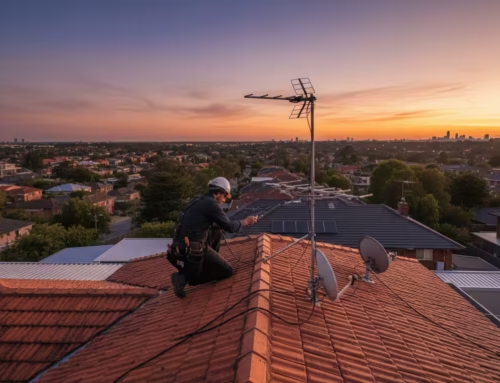
Every professional tv antenna repair visit begins with a comprehensive safety assessment. The Work Health and Safety Regulation 2017 (NSW) requires specific protocols for working at heights, including risk assessment, fall prevention measures, and appropriate personal protective equipment. Licensed cablers inspect roof access points, assess structural integrity, identify potential hazards such as loose tiles or overhead power lines, and establish safe working zones before ascending to the antenna location.
During the roof inspection, the technician examines the antenna mounting system for corrosion, loose mast clamps, damaged J-mounts or tilt mounts, and structural stability. Weather exposure gradually degrades mounting hardware, particularly in coastal Sydney suburbs including Coogee, Vaucluse, Manly, and Maroubra where salt air accelerates corrosion. The technician also inspects the antenna elements themselves, checking for physical damage, misalignment, or deterioration that affects signal reception.
This visual inspection provides immediate insight into obvious problems such as storm damage, bird interference, or vegetation growth that blocks the signal path to Sydney’s main broadcast transmitters at Artarmon, Gore Hill, and the Blue Mountains. However, many reception issues stem from less visible problems within the coaxial cable network or distribution system, requiring detailed signal diagnostics.
Comprehensive Antenna and Signal Diagnostics
Following the physical inspection, the technician performs systematic signal diagnostics using professional-grade testing equipment. This process identifies whether reception problems originate at the antenna, within the coaxial cable distribution network, at the distribution amplifier or splitter, or at individual wall outlets. Understanding when to repair versus replace your antenna depends on accurate diagnostic data that distinguishes between component failure and system-wide issues.
- 1 Antenna Terminal TestingThe technician measures signal strength directly at the antenna terminals before the signal enters the distribution system, establishing baseline reception quality from broadcast transmitters.
- 2 Coaxial Cable AssessmentSignal loss through damaged or degraded coaxial cable significantly impacts reception. The technician tests cable integrity, checks for water ingress at connection points, and measures signal attenuation across cable runs.
- 3 Distribution Amplifier and Splitter TestingIn multi-television installations, distribution amplifiers boost signal strength while splitters divide the signal to multiple outlets. Failed amplifiers or corroded splitters cause reception problems across all connected TVs.
- 4 Wall Outlet Signal VerificationThe technician tests signal strength at each wall outlet throughout the property, identifying whether problems affect the entire system or isolated locations due to faulty outlets or internal wiring issues.
This systematic approach isolates the fault location, enabling targeted repairs rather than unnecessary component replacement. Sydney Cabling’s lead technician Fred emphasises that accurate diagnostics save homeowners money by addressing the actual problem rather than replacing functioning equipment based on guesswork.
Testing Signal Strength: Understanding dBm and dBi Measurements
Professional signal testing relies on precise measurements expressed in decibels. Signal strength measured in dBm (decibels relative to one milliwatt) indicates the power level received at any point in the antenna system. For reliable digital television reception in Sydney, signal strength should typically measure between -30 dBm and -60 dBm at the antenna terminals. Readings above -30 dBm may overload the tuner, while readings below -60 dBm produce pixelation and dropouts.
Antenna gain, measured in dBi (decibels relative to an isotropic radiator), indicates how effectively the antenna concentrates signal reception in a specific direction. High-gain UHF antennas used in fringe reception areas around Dural, Castle Hill, and Seven Hills typically provide 10-15 dBi gain, focusing reception toward distant transmitters while rejecting interference from other directions.
Beyond raw signal strength, technicians also assess signal quality using Modulation Error Ratio (MER) measurements and signal-to-noise ratio testing. Digital television requires not just adequate signal strength but also clean signal quality free from interference, multipath distortion, and electrical noise. Professional testing equipment displays these parameters simultaneously, providing a complete picture of reception conditions and identifying issues invisible to basic signal meters.
Techniques for improving antenna signal strength depend on these diagnostic measurements, determining whether reception problems require antenna repositioning, upgraded components, or interference mitigation.
Common Repair Tasks: From Coaxial Cable Replacement to Antenna Realignment
Once diagnostics identify the fault, the technician proceeds with appropriate repairs using professional-grade components and installation techniques. The most common tv antenna repair tasks include:
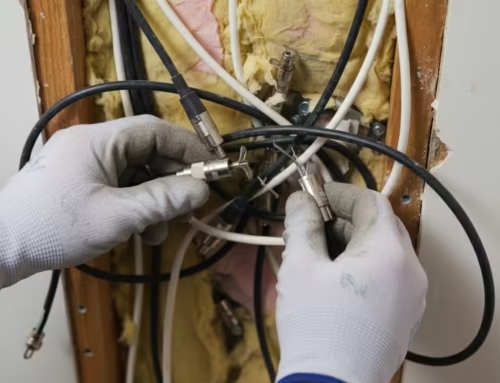
Coaxial cable replacement represents the most frequent repair task. Australian conditions deteriorate cable insulation over time, particularly in exposed roof spaces where temperature extremes and UV exposure accelerate degradation. Professional installations use RG6 quad-shield cable for standard runs and RG11 cable for longer distances where signal loss must be minimised. All connections receive properly crimped compression F-type connectors rather than twist-on connectors that loosen over time and allow moisture ingress.
Antenna realignment addresses reception problems caused by physical displacement. Even minor misalignment significantly reduces signal strength from directional UHF antennas. Using signal strength measurements as feedback, the technician adjusts antenna orientation in both horizontal (azimuth) and vertical (elevation) planes, securing the antenna in the optimal position with properly tightened mast clamps.
Distribution amplifier replacement becomes necessary when the unit fails due to component degradation or power surge damage. Modern distribution amplifiers provide separate gain adjustment for UHF and VHF frequencies, enabling optimised signal levels across all channels. The technician selects amplifier gain based on measured signal strength, avoiding over-amplification that causes intermodulation distortion.
Licensing Requirements: Why ACMA Registration Matters for Your Repair
The Australian Communications and Media Authority (ACMA) Cabling Provider Rules 2014 establish mandatory licensing for all telecommunications cabling work, including antenna installation and repair. Only technicians holding Open Cabler Registration may legally perform work on coaxial cable systems, antenna connections, and distribution equipment. This regulatory framework protects consumers from substandard work that compromises signal quality and creates safety hazards.
Important:
NSW Fair Trading enforces consumer protection standards for antenna services, requiring licensed cablers to provide written quotes, maintain appropriate insurance, and honour warranty obligations. When choosing a qualified antenna technician, homeowners should verify current ACMA registration, request proof of public liability insurance, and obtain detailed written documentation of all work performed.
Sydney Cabling maintains full ACMA Cabling Provider Registration and comprehensive insurance coverage across all service areas including Lindfield, St Ives, Forestville, Killara, Brookvale, Bayview, and surrounding Greater Sydney suburbs. Our 15+ years of operation and over 40,000 completed jobs demonstrate consistent compliance with telecommunications regulations and safety standards.
Post-Repair Testing and Channel Tuning Across All TVs
Professional antenna repair service includes comprehensive post-repair verification across all connected televisions. After completing physical repairs, the technician re-measures signal strength at the antenna terminals, distribution points, and wall outlets, confirming that all readings fall within optimal ranges for reliable digital television reception.
Channel tuning represents a critical final step often overlooked in amateur repairs. Digital television tuners must scan for available channels after any antenna work, as signal changes may affect channel detection. The technician performs a complete channel scan on each television, verifying that all available free-to-air services appear in the channel list and that picture quality remains consistent across UHF and VHF frequencies.
This testing process identifies any remaining issues before the technician leaves the property. If signal distribution problems persist at specific outlets, the technician traces cable paths, checks splitter connections, and verifies that signal levels remain adequate throughout the distribution network. Proper testing ensures that repairs address the underlying problem rather than providing temporary improvement that fails within days or weeks.
Documentation, Warranty, and Ongoing Maintenance Advice
Professional antenna repair services provide detailed written documentation of all work performed, including components replaced, signal strength measurements before and after repair, and warranty coverage. This documentation proves valuable for property records, insurance claims, and future service visits.
- ✓
Request a written quote detailing parts, labour, and warranty terms before authorising repair work - ✓
Ask the technician to explain signal strength measurements (dBm) and antenna gain (dBi) readings taken during testing - ✓
Obtain documentation of all work completed, including cable types used (RG6/RG11), parts replaced, and warranty coverage
Warranty terms vary between service providers, with reputable companies offering substantial coverage on both parts and labour. Sydney Cabling provides up to 20 years warranty on certain parts and labour, reflecting confidence in workmanship quality and component selection. This extended warranty coverage significantly exceeds industry standards and provides long-term value for property owners.
The technician also provides maintenance advice specific to your antenna system and location. Coastal properties require more frequent inspection due to salt air corrosion, while properties near airports or industrial areas may experience periodic interference requiring monitoring. Understanding preventative antenna maintenance helps homeowners avoid future reception problems and extends system lifespan.
Professional technicians explain how to recognise early warning signs of developing problems, such as intermittent pixelation during specific weather conditions or gradual signal degradation affecting certain channels. Early intervention prevents minor issues from escalating into complete system failure requiring emergency repairs.
Homeowners should also understand typical antenna repair and installation costs to make informed decisions about repair versus replacement when significant component failure occurs. Transparent pricing and detailed explanations help property owners budget appropriately for antenna system maintenance.
Frequently Asked Questions About TV Antenna Repair Visits
Do I need a licensed cabler for TV antenna repairs in Sydney?
Yes. Under the Australian Communications and Media Authority (ACMA) Cabling Provider Rules 2014, all work on coaxial cabling and antenna systems must be performed by an ACMA-registered cabler holding Open Cabler Registration. DIY antenna repairs can result in poor signal quality, safety hazards, and potential fines.
How long does a typical TV antenna repair visit take?
Most antenna repair visits take 1-2 hours depending on the issue. Simple repairs like replacing damaged coaxial cable (RG6 or RG11) or realigning the antenna may take 45-60 minutes, while complex issues involving distribution amplifiers, splitters, or mast replacement can take 2-3 hours.
What signal strength should my TV antenna achieve in Sydney?
For reliable digital TV reception in Sydney, signal strength should typically measure between -30 dBm and -60 dBm at the antenna terminals. Licensed cablers use calibrated signal meters to measure both signal strength (dBm) and quality, ensuring your antenna achieves optimal gain (measured in dBi) from Sydney’s main transmitters at Artarmon, Gore Hill, and the Blue Mountains.
Will the technician test all my TVs after the repair?
Yes. A professional repair service includes testing signal distribution to all connected TVs, retuning channels to ensure all available free-to-air services are accessible, and verifying picture quality across UHF and VHF frequencies. This ensures the entire system—from antenna to distribution amplifier to wall outlets—functions correctly.
What warranty should I expect on antenna repair work?
Reputable antenna repair services in Sydney should provide warranties on both parts and labour. Sydney Cabling offers up to 20 years on certain parts and labour, covering workmanship and installed components. Always request written warranty documentation and ensure the cabler is ACMA-registered for consumer protection under NSW Fair Trading regulations.
Sydney Cabling’s ACMA-registered technicians have completed over 40,000 antenna installations and repairs across Greater Sydney in 15+ years. We provide transparent diagnostics, quality repairs using professional-grade components, and up to 20 years warranty on certain parts and labour. Contact us today for a comprehensive antenna repair service visit.
ACMA licensed. 15+ years experience. Over 40,000 completed jobs across Greater Sydney. Up to 20-year warranty on parts and labour.