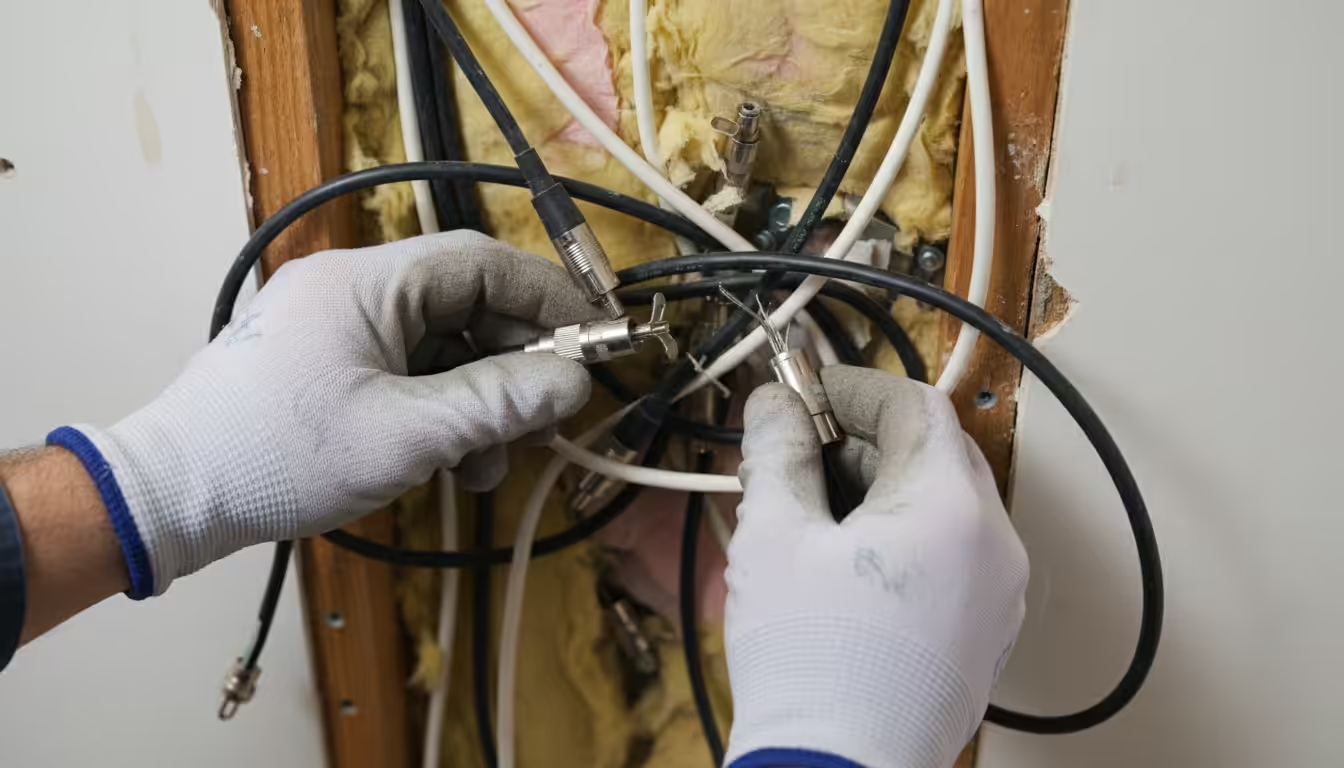
When your television signal drops out or pixelates unexpectedly, the problem often lies not with your antenna but with the coaxial cable connecting it to your television. Searching for tv cable repair near me typically leads Sydney homeowners to discover that cable failures stem from specific technical causes—many of which are invisible until signal quality degrades below usable thresholds. As an ACMA-licensed cabler who has diagnosed cable faults across thousands of Sydney properties, I can confirm that most TV cable failures follow predictable patterns linked to installation quality, environmental exposure, and material degradation. Understanding these root causes helps property managers and homeowners recognise when professional cable assessment becomes necessary, and why the Telecommunications Act 1997 (Cth) requires licensed cablers to perform all coaxial cable installation and repair work.
According to the Australian Communications and Media Authority (ACMA), over 5.5 million Australian households rely on free-to-air digital television, making properly installed and maintained coaxial cabling infrastructure essential for signal delivery. Yet cable failures remain one of the most common causes of reception problems across Greater Sydney, from coastal suburbs like Manly and Coogee to inland areas such as Parramatta and Penrith. Sydney Cabling has resolved cable-related signal issues across 40,000+ installations over 15 years, and our diagnostic work consistently reveals the same underlying technical failures.
What Causes TV Cable Failure? Understanding the Root Issues
TV cable failure occurs when the coaxial cable’s ability to transmit radio frequency signals from antenna to television degrades beyond the minimum threshold required for digital reception. Unlike analogue television, which could display degraded images with weak signals, digital TV requires a minimum signal strength (typically -65 dBm to -30 dBm depending on location and broadcaster) and acceptable Modulation Error Ratio (MER) values above 20 dB for stable reception. When cable faults introduce signal loss, impedance mismatches, or noise, the digital tuner receives insufficient data to reconstruct the video stream, resulting in pixelation, freezing, or complete signal loss.
The Australian Bureau of Statistics reports that Sydney’s coastal suburbs experience average annual rainfall of 1,200-1,400mm, with humidity levels regularly exceeding 65 per cent, accelerating cable degradation and connector corrosion without proper weatherproofing. This environmental stress, combined with UV exposure, physical damage, and poor installation practices, creates multiple failure pathways that compromise signal integrity over time.
Physical Damage to Coaxial Cable Shielding
Coaxial cable consists of a central copper conductor surrounded by dielectric insulation, metallic braided shielding, and an outer protective jacket. The braided shield serves two critical functions: it prevents external radio frequency interference from entering the cable, and it maintains the 75-ohm impedance required for efficient signal transmission. When physical damage compromises this shielding—through crushing, abrasion, animal damage, or improper installation—the cable becomes susceptible to interference and signal leakage.
Common physical damage scenarios include cables crushed by roof tiles during maintenance work, cables abraded against sharp roof edges or wall penetrations, and cables damaged by possums or birds seeking nesting material. In multi-dwelling properties, cables routed through ceiling spaces may be damaged during electrical or air conditioning work by contractors unaware of the cabling infrastructure. Even minor damage to the outer jacket can expose the braided shield to moisture, initiating corrosion that progressively degrades shielding effectiveness.
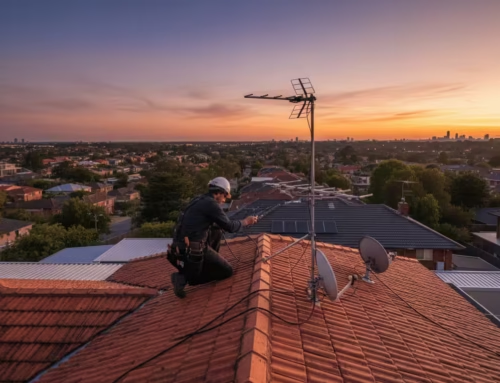
Fred, our lead technician at Sydney Cabling, frequently encounters cable damage at roof penetration points where cables enter the building envelope. Without proper cable entry boots or grommets, the sharp edges of metal or tile roofing gradually wear through the cable jacket during thermal expansion and contraction cycles. This type of damage often goes unnoticed until signal quality deteriorates significantly, at which point homeowners search for tv cable repair near me to address the underlying fault. Understanding the 5 signs your TV antenna needs repair helps property owners recognise when cable damage may be affecting reception quality.
UV Degradation and Weather Exposure in Sydney’s Climate
The outer jacket of coaxial cable protects internal components from environmental damage, but prolonged exposure to ultraviolet radiation breaks down the polymer chains in PVC and polyethylene jacket materials. Sydney’s high UV index—regularly reaching 11+ during summer months—accelerates this photodegradation process, causing cable jackets to become brittle, crack, and eventually disintegrate. Once the jacket fails, moisture penetrates to the dielectric insulation and braided shield, initiating corrosion and signal degradation.
Quality RG6 coaxial cable specified for outdoor use incorporates UV-resistant additives in the jacket formulation and typically includes a black carbon-loaded outer layer that absorbs UV radiation before it reaches structural polymer layers. However, even UV-rated cable degrades over time, with typical service life ranging from 10 to 15 years in direct sunlight exposure. Non-UV-rated cable—sometimes incorrectly installed by unlicensed operators—can fail in as little as 3 to 5 years when exposed to Sydney’s climate.
Coastal suburbs face additional challenges from salt-laden air, which accelerates corrosion of metallic cable components once jacket integrity fails. Properties in suburbs like Bondi, Maroubra, and Bayview require particular attention to cable weatherproofing and regular inspection schedules. Implementing regular TV antenna maintenance allows licensed cablers to identify UV degradation before complete cable failure occurs, preventing sudden signal loss and reducing long-term replacement costs.
By the Numbers
- STATAccording to the Australian Communications and Media Authority (ACMA), over 5.5 million Australian households rely on free-to-air digital television, making properly installed and maintained coaxial cabling infrastructure essential for signal delivery
- STATThe Australian Bureau of Statistics reports that Sydney’s coastal suburbs experience average annual rainfall of 1,200-1,400mm, with humidity levels regularly exceeding 65 per cent, accelerating cable degradation and connector corrosion without proper weatherproofing
Water Ingress and Connector Corrosion
Water ingress represents one of the most common and destructive failure mechanisms in TV antenna cabling systems. When moisture enters the coaxial cable system—whether through damaged jacketing, poorly sealed connectors, or inadequate weatherproofing at termination points—it creates multiple signal degradation pathways. Water within the dielectric insulation changes the cable’s electrical properties, altering impedance from the required 75 ohms and increasing signal loss. Moisture on the braided shield initiates galvanic corrosion, progressively reducing shielding effectiveness and allowing external interference to contaminate the signal.
F-type connectors, which terminate coaxial cable at wall plates, splitters, and television inputs, are particularly vulnerable to water ingress. Compression F-connectors, when properly installed by licensed cablers, create a weatherproof seal between the cable jacket and connector body. However, crimp-style connectors—still occasionally encountered in older installations—provide less reliable sealing and are more susceptible to moisture penetration. Once water enters a connector, it corrodes the brass or nickel-plated threads and centre pin, increasing contact resistance and introducing signal reflections that degrade Modulation Error Ratio values.
Sydney’s weather patterns create ideal conditions for water-related cable failures. Heavy rainfall events, common during autumn and winter months, can overwhelm inadequate weatherproofing at antenna connection points and roof penetrations. Homeowners often notice that signal quality deteriorates during or immediately after rain, then partially recovers as connectors dry—a clear indication of water ingress requiring professional assessment. Learning how weather affects your antenna and cabling helps property managers understand why signal problems correlate with environmental conditions and why proper weatherproofing during initial installation is essential.
Signal Loss from Impedance Mismatch and Poor Termination
Television antenna systems operate at 75-ohm impedance, a standard that ensures maximum power transfer from antenna to television with minimum signal reflection. When cable faults, poor terminations, or incorrect components introduce impedance mismatches, a portion of the signal reflects back toward the antenna rather than continuing to the television. These reflections create standing waves within the cable, reducing effective signal strength and introducing phase distortions that degrade digital reception quality.
Common sources of impedance mismatch include damaged cable where the dielectric insulation has been compressed or deformed, poorly installed F-connectors where the centre conductor protrudes too far or not far enough, and mixing of cable types with different impedance characteristics. Some older installations incorrectly use 50-ohm cable—typically intended for data communications—for TV antenna connections, creating a fundamental impedance mismatch that cannot be corrected without complete cable replacement.
Signal loss also accumulates along cable length, with RG6 coaxial cable typically exhibiting 5 to 6 dB loss per 100 metres at UHF frequencies (500-800 MHz). While this loss is acceptable for most residential installations, excessive cable length, poor quality cable, or multiple splitters can reduce signal strength below the minimum threshold required for reliable digital reception. Licensed cablers measure signal strength in dBm at the antenna, at intermediate distribution points, and at television outlets to verify that adequate signal margin exists throughout the system. When homeowners experience reception problems, troubleshooting weak TV signals requires systematic measurement and analysis to identify whether cable faults contribute to signal degradation.
Poor Quality Cable Installation and Termination
Installation quality directly determines cable system longevity and reliability. Poor installation practices—including inadequate cable support, excessive bend radius, improper connector termination, and insufficient weatherproofing—create failure points that progressively degrade signal quality over time. Under the Australian Communications and Media Authority (ACMA) Cabling Provider Rules 2014, all coaxial cable installation work must be performed by ACMA-registered cablers who understand proper installation techniques and compliance requirements.
Common installation defects include cables bent beyond the minimum bend radius specified by manufacturers (typically 10 times the cable diameter for RG6), creating stress points where the dielectric insulation separates from the centre conductor. Cables installed without adequate UV protection in exposed locations, cables routed across sharp edges without protection, and cables inadequately secured allowing wind movement all represent installation defects that lead to premature failure. At termination points, improperly prepared cables where braided shield strands contact the centre conductor create short circuits, while connectors installed without proper compression tools fail to create reliable weatherproof seals.
The quality difference between licensed professional installation and unlicensed work becomes apparent over time. Sydney Cabling’s installations incorporate proper cable support at maximum 1-metre intervals, weatherproof compression F-connectors at all termination points, UV-rated cable for all outdoor runs, and proper cable entry sealing at building penetrations. These installation practices, combined with our understanding of signal distribution principles explained in our practical guide to antenna systems and signal reception, ensure that cable systems deliver reliable performance throughout their service life and justify our up to 20-year warranty on certain parts and labour.
Important:
Interference from Electrical Systems and Distribution Amplifier Failure
External interference from electrical systems represents a less common but significant cause of cable system failure. When coaxial cable shielding degrades through physical damage, corrosion, or poor installation, the cable becomes susceptible to electromagnetic interference from nearby electrical wiring, solar inverters, LED lighting drivers, and other electronic devices. This interference manifests as noise that reduces the signal-to-noise ratio, degrading Modulation Error Ratio values and causing pixelation or signal loss on affected channels.
Distribution amplifiers, used in properties with multiple television outlets or weak signal areas, can also fail and cause system-wide reception problems. These active devices boost signal strength to compensate for splitter loss and cable length, but they require mains power and contain electronic components subject to heat-related failure. Amplifier failure typically causes complete signal loss to all connected outlets, while partial amplifier degradation may introduce noise or distortion that affects signal quality. Quality distribution amplifiers incorporate surge protection and thermal management, but even well-designed units have finite service lives typically ranging from 10 to 15 years.
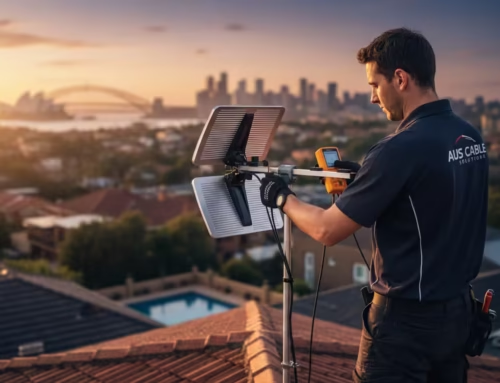
Diagnosing interference and amplifier issues requires specialised test equipment including spectrum analysers and signal level meters. Licensed cablers can identify interference sources, measure noise floor levels, and verify amplifier performance across the UHF and VHF frequency ranges. When searching for tv aerial cable installation near me, property owners should prioritise ACMA-registered cablers with diagnostic capabilities to identify complex failure modes beyond simple cable damage.
Why Licensed Cabler Work Matters for Cable Longevity
The requirement for licensed cabler work under the Telecommunications Act 1997 (Cth) exists not merely as regulatory burden but as essential consumer protection ensuring that cabling work meets technical standards, complies with safety requirements, and delivers reliable long-term performance. ACMA-registered cablers complete formal training in cable installation techniques, signal distribution principles, and compliance requirements, and they carry professional indemnity insurance protecting property owners from liability arising from installation defects.
Licensed cablers understand the technical requirements that prevent the failure modes discussed throughout this article. They select appropriate cable types for each application, install weatherproof terminations that resist moisture ingress, route cables to avoid physical damage and UV exposure, maintain proper bend radius throughout cable runs, and verify signal levels to ensure adequate margin for reliable reception. This technical knowledge, combined with access to professional-grade materials and tools, directly translates to extended cable system life and reduced failure rates.
The Work Health and Safety Act 2011 (NSW) and Work Health and Safety Regulation 2017 (NSW) impose additional requirements for work at heights, including roof access for antenna and cable installation. Licensed cablers implement fall protection systems, use appropriate access equipment, and follow safe work procedures that protect both the tradesperson and property occupants. Unlicensed operators working on roofs without proper safety systems expose themselves and property owners to serious injury risk and potential liability.
Sydney Cabling holds Open Cabler Registration covering structured cabling, coaxial cabling, and optical fibre work, ensuring that our technicians can address all aspects of TV antenna and cabling systems. Our 15 years of operation and 40,000+ completed installations across Greater Sydney demonstrate the reliability that comes from proper licensing, ongoing training, and commitment to technical excellence. Property owners researching when to repair or replace your TV antenna system should prioritise licensed cablers who can provide comprehensive assessment and compliant solutions backed by meaningful warranties.
When to Call Sydney Cabling for TV Cable Diagnosis
Homeowners and property managers should arrange professional cable assessment when experiencing any of the following symptoms: pixelation or freezing affecting multiple channels, complete signal loss on some or all channels, reception quality that deteriorates during or after rain, visible cable damage including cracked jacketing or exposed braiding, corroded or damaged connectors at wall plates or equipment, or intermittent reception problems that worsen over time. These symptoms indicate underlying cable faults requiring diagnostic measurement and professional repair.
While homeowners can safely perform visual inspection of accessible cable runs and check connector tightness at wall plates, any work involving cable repair, connector replacement, or system modification must be performed by an ACMA-registered cabler. The diagnostic process includes signal strength measurement at multiple system points, inspection of all cable runs and terminations, verification of proper earthing and surge protection, assessment of distribution amplifier function if present, and identification of any installation defects or environmental damage requiring remediation.
Sydney Cabling provides comprehensive cable diagnostic services across all Greater Sydney suburbs, from coastal areas including Manly, Bondi, and Cronulla to western suburbs including Parramatta, Blacktown, and Penrith. Our technicians carry professional signal measurement equipment, maintain stocks of quality RG6 cable and compression F-connectors, and can complete most cable repairs during the initial service visit. We provide detailed diagnostic reports explaining identified faults, recommended remediation, and expected signal performance improvements following repair work.
Frequently Asked Questions
How long does RG6 coaxial cable last outdoors in Sydney?
Quality RG6 coaxial cable with UV-resistant jacketing typically lasts 10 to 15 years in Sydney’s climate when properly installed. However, cables exposed to direct sunlight, salt air in coastal suburbs like Coogee or Manly, or installed without proper weatherproofing can degrade in as little as 3 to 5 years. Under the Australian Communications and Media Authority (ACMA) Cabling Provider Rules 2014, only licensed cablers can install or repair coaxial cabling to ensure compliance with Australian standards.
Can I repair TV aerial cable myself or do I need a licensed cabler?
Under the Telecommunications Act 1997 (Cth) and the Australian Communications and Media Authority (ACMA) Cabling Provider Rules 2014, all coaxial cable installation, repair, and termination work must be performed by an ACMA-registered cabler. Homeowners can safely check for visible damage or loose connections at wall plates, but any cable cutting, splicing, or connector replacement requires a licensed professional. Sydney Cabling holds Open Cabler Registration for structured, coaxial, and optical fibre cabling work.
What’s the difference between RG6 and RG11 cable for TV antennas?
RG6 coaxial cable (75-ohm impedance, 6.9mm diameter) is the Australian standard for residential TV antenna installations up to 100 metres, offering low signal loss of approximately 5 to 6 dB per 100m at UHF frequencies. RG11 cable (75-ohm, 10.3mm diameter) provides lower signal loss (approximately 4 dB per 100m) and is used for longer cable runs in commercial installations or properties with weak signal areas. Both must be installed by ACMA-licensed cablers to maintain signal integrity and compliance.
Why does my TV signal get worse when it rains in Sydney?
Rain-related signal degradation typically indicates water ingress at cable connectors, F-type terminations, or through damaged cable jacketing. Water creates impedance mismatches and signal reflections, reducing signal strength (measured in dBm) below the minimum threshold required for digital TV reception. Coastal Sydney suburbs like Maroubra and Bayview experience accelerated connector corrosion from salt air, making proper weatherproofing and compression F-connectors essential during installation by licensed cablers.
How do I know if my TV cable needs repair or replacement?
Signs requiring professional assessment include pixelation or freezing on multiple channels, complete signal loss, visible cable damage (cracked jacketing, exposed braiding), corroded connectors, or intermittent reception that worsens in wet weather. A licensed cabler will measure signal strength in dBm at multiple points, check impedance matching, inspect all terminations, and test for water ingress. Sydney Cabling provides comprehensive cable diagnostics across Greater Sydney and offers up to 20 years warranty on certain parts and labour.
Sydney Cabling has diagnosed and resolved TV cable failures across 40,000+ installations in Greater Sydney over 15 years. Our ACMA-registered cablers identify root causes—from impedance mismatches to water ingress—and deliver compliant repairs backed by up to 20 years warranty on certain parts and labour. Contact us today for professional cable assessment.
ACMA licensed. 15+ years experience. Over 40,000 completed jobs across Greater Sydney. Up to 20-year warranty on parts and labour.