By the Numbers
- STATAccording to the Australian Communications and Media Authority (ACMA), over 13 million Australians access free-to-air digital television, making antenna signal quality a critical household service issue
- STATThe ACMA reports that improper cabling work is a leading cause of consumer complaints to NSW Fair Trading, with signal degradation often traced to non-compliant splitter installations or corroded connections
Pixelated screens, freezing images, and missing channels frustrate Sydney homeowners who assume their antenna has failed. Before spending hundreds on a replacement, understanding how to boost digital antenna signal through targeted improvements to your existing system can restore picture quality at a fraction of the cost. Many signal issues stem from corroded connections, outdated coaxial cable, or excessive splitter loss rather than antenna failure itself.
As an ACMA-licensed cabler with over 40,000 completed jobs across Greater Sydney, I regularly restore full signal strength without touching the antenna. This guide explains seven proven methods to improve reception, the technical specifications that determine signal quality, and the legal requirements under the Australian Communications and Media Authority (ACMA) Cabling Provider Rules 2014 that distinguish safe homeowner inspections from work requiring a licensed professional. If you recognise signs your TV antenna needs repair, these steps help identify whether the problem lies in your cabling infrastructure rather than the antenna itself.
Understanding Digital TV Signal Strength: dBm, dBi, and What Your TV Actually Needs
Digital television reception depends on signal strength measured in dBm (decibels relative to one milliwatt) reaching your TV tuner. Most digital tuners require a minimum signal level between -65 dBm and -70 dBm to decode broadcast channels reliably. Signal weaker than this threshold causes pixelation, freezing, or complete loss of picture.
Antenna gain, measured in dBi (decibels relative to an isotropic radiator), determines how effectively your antenna captures broadcast signals from Sydney transmitters at Artarmon, Gore Hill, and North Head. A typical UHF antenna for Sydney metropolitan reception offers 10-14 dBi gain. However, signal loss occurs throughout the cabling system between antenna and TV through coaxial cable attenuation, splitter insertion loss, and connector degradation.
Understanding how antennas work and affect TV reception helps identify where signal degradation occurs. A properly oriented antenna with 12 dBi gain receiving -45 dBm at the antenna terminals may deliver only -58 dBm to your TV after passing through 20 metres of RG6 cable (3 dB loss), a four-way splitter (7 dB loss), and two F-type connectors (0.5 dB loss each). This 11 dB total loss still provides adequate signal, but adding one more splitter or replacing RG6 with inferior RG59 cable pushes signal below the minimum threshold.
Check Your Coaxial Cable Connections First (Safe Homeowner Inspection)
Before calling a licensed cabler, homeowners can safely inspect accessible coaxial cable connections inside the home. This preliminary check often identifies obvious faults without requiring roof access or cable termination work regulated under the Telecommunications Act 1997 (Cth).
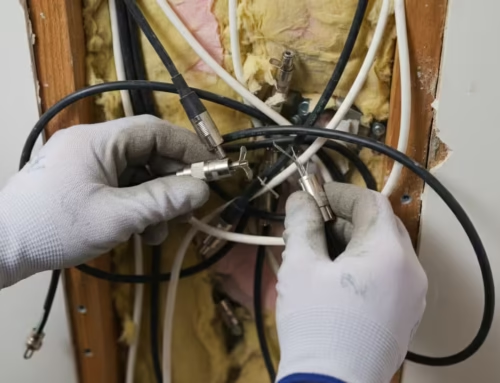
- 1 Inspect F-type connectors at wall plates and TV inputsExamine the threaded F-type connectors where coaxial cable attaches to wall outlets and television inputs. Green or white corrosion on the brass connector indicates moisture ingress, which increases resistance and degrades signal. Loose connections allow interference and reduce signal transfer efficiency.
- 2 Check for visible cable damage along accessible runsExamine coaxial cable runs visible in roof spaces, under floors, or along walls for kinks, crushing, or damaged outer insulation. Sharp bends exceeding the cable’s minimum bend radius (typically 6 times the cable diameter for RG6) damage the internal dielectric and centre conductor, causing signal loss and impedance mismatches.
- 3 Tighten hand-loose connectionsUsing fingers only (no tools), gently tighten any F-type connectors that rotate freely. Over-tightening with pliers damages the connector and wall plate threads. If connectors remain loose after hand-tightening, the connector may be stripped or improperly installed, requiring replacement by an ACMA-registered cabler.
- 4 Note which rooms experience signal problemsDocument whether all TVs lose signal simultaneously or only specific outlets fail. Problems affecting a single room typically indicate a faulty cable run or wall plate connection to that outlet. Issues affecting all TVs suggest antenna misalignment, amplifier failure, or a fault in the main cable run from the antenna.
This inspection provides valuable diagnostic information when you contact Sydney Cabling for a professional assessment. Our lead technician Fred uses this preliminary data to identify likely fault locations before arriving on site, reducing diagnostic time and service costs. For systematic approaches to signal diagnosis, refer to our guide on troubleshooting weak TV signals.
Upgrade Your Coaxial Cable: RG6 vs RG11 and Why It Matters for Signal Loss
Coaxial cable type directly determines signal loss between antenna and TV. Older installations using RG59 cable (common in homes built before 2000) exhibit significantly higher attenuation than modern RG6 quad-shield cable, the current Australian standard for digital TV installations.
Replacing RG59 cable with RG6 quad-shield reduces signal loss by approximately 2.5 dB over a 30-metre run. In systems already operating near the minimum signal threshold, this improvement often eliminates pixelation and restores missing channels without any other modifications.
RG11 cable provides even lower attenuation for very long cable runs common in large homes or properties with antennas mounted on distant masts. The thicker centre conductor (1.63 mm vs 1.02 mm in RG6) reduces resistance and signal loss, but requires larger bend radius and specialized compression connectors.
Important:
Sydney Cabling uses exclusively RG6 quad-shield cable for standard residential installations and RG11 for runs exceeding 30 metres or where maximum signal preservation is required. Our cable installations include proper support spacing, minimum bend radius compliance, and compression F-type connectors that maintain 75-ohm impedance throughout the system.
Install or Upgrade a Distribution Amplifier (Masthead or Inline)
Distribution amplifiers boost signal strength to compensate for losses caused by long cable runs, multiple splitters, or weak transmission from Sydney broadcast towers. Two types serve different applications: masthead amplifiers mounted at the antenna and inline amplifiers installed within the home near the first splitter.
Masthead amplifiers provide 15-25 dB gain and mount directly at the antenna terminals before signal travels through coaxial cable. This location amplifies signal before cable attenuation occurs, providing maximum benefit for long cable runs or properties distant from transmitters. Masthead amplifiers require power injectors installed indoors that send 12-24V DC up the coaxial cable to the amplifier.
Inline amplifiers (also called distribution amplifiers) install inside the roof space or wall cavity near the main splitter, providing 10-20 dB gain. These suit homes with adequate signal at the antenna but excessive splitter loss distributing to multiple rooms. Inline amplifiers plug into standard 240V AC power outlets and include multiple output ports with individual gain adjustment.
Our professional antenna signal boosting solutions include signal strength testing to determine optimal amplifier type, gain level, and installation location. Over-amplification causes signal overload and intermodulation distortion, producing the same pixelation symptoms as weak signal. Fred measures signal levels at multiple points in your system to calculate precise amplification requirements.
Important:
Replace Corroded or Low-Quality Splitters and Joiners
Splitters divide antenna signal to multiple TVs, with each split causing insertion loss measured in decibels. A two-way splitter causes approximately 3.5 dB loss per output, a three-way splitter causes 5.5 dB loss, and a four-way splitter causes 7 dB loss. These losses compound when splitters cascade (one splitter feeding another), rapidly degrading signal below usable levels.
Low-quality splitters from hardware stores often lack proper impedance matching and shielding, causing additional signal loss beyond theoretical insertion loss values. Corroded splitters exhibit even worse performance as oxidation increases resistance at connection points. Splitters installed in roof spaces without weatherproof enclosures corrode rapidly in Sydney’s humid coastal climate.
Professional-grade splitters specify insertion loss, return loss, and frequency response across the entire UHF band (470-860 MHz). Quality splitters maintain consistent 75-ohm impedance and include gold-plated F-type connectors that resist corrosion. Shielded die-cast housings prevent interference from mobile phone signals, Wi-Fi, and other RF sources.
During signal assessments, Sydney Cabling replaces corroded or substandard splitters with broadcast-grade components that minimize insertion loss and maintain signal integrity. We also relocate splitters from exposed roof spaces to protected wall cavities where temperature and humidity remain stable.
Reorient Your Existing Antenna Toward Sydney Transmitters (Licensed Cabler Required)
Antenna orientation directly affects received signal strength, with even small misalignments reducing signal by 5-10 dB. Sydney metropolitan areas receive digital television broadcasts from three primary transmitter sites: Artarmon (serving the North Shore and Inner West), Gore Hill (serving the CBD and Eastern Suburbs), and North Head (serving coastal areas from Manly to Cronulla).
UHF antennas exhibit directional gain patterns, with maximum sensitivity in the direction the antenna elements point. Wind, storm damage, or improper initial installation cause antennas to rotate away from optimal alignment. Trees growing since original installation may now obstruct the signal path, requiring antenna reorientation toward a different transmitter or mounting at increased height.
Professional antenna reorientation involves measuring signal strength from each available transmitter using a spectrum analyzer, calculating optimal azimuth based on property location and obstructions, and adjusting antenna mounting hardware to achieve precise alignment. Techniques for optimising TV antenna reception include polarization adjustment (vertical vs horizontal element orientation) and elevation angle optimization for properties on slopes or in valleys.
Important:
Sydney Cabling’s antenna reorientation service includes comprehensive signal testing from all available Sydney transmitters, precise azimuth calculation using GPS coordinates and transmitter databases, and secure remounting using appropriate hardware for your roof type. Our 15+ years of experience across Greater Sydney means we understand local signal propagation patterns, common obstruction issues in specific suburbs, and optimal antenna configurations for challenging reception areas.
Remove Unnecessary Splitters to Reduce Signal Loss
Many Sydney homes contain splitters feeding wall outlets that no longer connect to active televisions. Each unused splitter output still causes insertion loss affecting all other outputs, unnecessarily degrading signal to rooms with active TVs. Removing redundant splitters or replacing a four-way splitter with a two-way splitter when only two rooms require signal can improve signal strength by 3-4 dB.
Cascaded splitters (one splitter feeding another) compound signal loss exponentially. A common configuration in older homes involves a four-way splitter in the roof space (7 dB loss) feeding a two-way splitter in a bedroom (additional 3.5 dB loss), resulting in 10.5 dB total loss to that room. Reconfiguring the cabling to eliminate the cascade and run a dedicated cable from the main splitter reduces loss to 7 dB.
During system audits, Fred maps existing splitter configurations, identifies unused outputs, and calculates signal loss to each TV location. We then redesign the distribution system to minimize splitter count and eliminate cascades while maintaining service to all active outlets. This optimization often improves signal by 5-8 dB without installing amplifiers or replacing cable.
Understanding the importance of regular TV antenna maintenance includes periodic review of your distribution system as household TV locations change over time. What worked when you had five TVs may be over-engineered now that you have two, with unnecessary splitters degrading signal quality.
When ACMA-Licensed Cabler Work Is Legally Required Under the ACMA Cabling Provider Rules 2014
The Australian Communications and Media Authority (ACMA) Cabling Provider Rules 2014, enacted under the Telecommunications Act 1997 (Cth), establish strict licensing requirements for cabling work to ensure safety, signal quality, and interference prevention. These regulations distinguish between inspection activities homeowners may perform and installation work requiring ACMA registration.
Homeowners may legally inspect accessible coaxial cable connections, tighten loose F-type connectors by hand, and document signal problems affecting specific rooms. All other work requires an ACMA-registered cabler holding Open Cabler Registration, including:
- Installing, terminating, or replacing coaxial cable
- Installing or connecting distribution amplifiers, masthead amplifiers, or power injectors
- Installing, replacing, or adjusting TV antennas or mounting hardware
- Installing, replacing, or reconfiguring splitters, diplexers, or signal combiners
- Connecting coaxial cable to antenna terminals or wall outlets
- Any work requiring roof access or working at heights
NSW Fair Trading enforces these requirements and investigates complaints regarding unlicensed cabling work. Penalties for performing cabling work without ACMA registration include fines up to $13,320 for individuals and $66,600 for companies, as specified in the Telecommunications Act 1997 (Cth). More importantly, improper cabling work causes signal interference affecting neighbouring properties, creates safety hazards from incorrect antenna mounting, and voids insurance coverage if roof access results in injury.
Communications Alliance, the peak body for Australian telecommunications, maintains public resources explaining consumer rights and cabler obligations under the ACMA Cabling Provider Rules 2014. Homeowners should verify that any technician performing antenna or cabling work provides their ACMA registration number and carries appropriate public liability insurance. Our guide on when to call a licensed cabler instead of DIY explains these legal boundaries in detail.
Sydney Cabling holds ACMA Open Cabler Registration, carries $20 million public liability insurance, and complies with all requirements of the Work Health and Safety Act 2011 (NSW) for roof work and working at heights. Our technicians complete ongoing professional development to maintain registration and stay current with evolving telecommunications standards.
How Sydney Cabling Improves Signal Without Antenna Replacement
Our systematic approach to signal improvement begins with comprehensive testing using calibrated spectrum analyzers that measure signal strength in dBm, signal-to-noise ratio, and Modulation Error Ratio (MER) at multiple points throughout your system. This diagnostic data identifies whether signal problems originate at the antenna, within the cabling infrastructure, or from external interference sources.
In approximately 70 percent of service calls for weak signal, Fred identifies correctable issues in the distribution system rather than antenna failure. Common findings include corroded splitters causing 4-6 dB additional loss beyond specification, RG59 cable installed during the analogue television era, cascaded splitters creating unnecessary loss, or distribution amplifiers that have failed or provide incorrect gain for the system configuration.
Our signal improvement service includes:
- Complete system audit documenting cable types, splitter configuration, and signal levels at each TV outlet
- Replacement of substandard components with broadcast-grade splitters, connectors, and cable
- Distribution system redesign to eliminate unnecessary splitters and cascades
- Installation of appropriately specified distribution amplifiers where required
- Antenna reorientation toward optimal Sydney transmitter based on measured signal strength
- Verification testing at each outlet confirming signal strength exceeds minimum thresholds
This comprehensive approach costs significantly less than antenna replacement while delivering superior results. Our up to 20-year warranty on certain parts and labour provides long-term confidence in the quality of components and installation workmanship. With over 40,000 completed jobs across suburbs from Sutherland Shire to the Northern Beaches, Parramatta to the Eastern Suburbs, we understand the specific signal challenges affecting different areas of Greater Sydney.
- ✓
Inspect all accessible coaxial cable connections for corrosion, loose fittings, or visible damage (safe homeowner check) - ✓
Identify how many splitters are in your system and whether all outputs are actively used - ✓
Check if your coaxial cable is labelled RG6 or RG59 (RG59 is outdated and causes higher signal loss) - ✓
Measure approximate cable run distance from antenna to TV (runs over 20 metres benefit from amplification) - ✓
Note whether signal issues affect all TVs or only specific outlets (indicates splitter or cable fault) - ✓
Confirm your antenna is pointed toward Sydney transmitters at Artarmon, Gore Hill, or North Head - ✓
Verify that any signal boosting or antenna adjustment work is performed by an ACMA-registered cabler
Frequently Asked Questions
Can I boost my digital TV signal without replacing my antenna?
Yes, in most cases signal can be improved by upgrading coaxial cables to RG6 quad-shield, installing a distribution amplifier, replacing corroded splitters, or reorienting the antenna toward Sydney transmitters. Under the Australian Communications and Media Authority (ACMA) Cabling Provider Rules 2014, any work involving antenna adjustment or amplifier installation must be performed by an ACMA-registered cabler. Sydney Cabling’s diagnostic testing identifies which improvements deliver the greatest signal increase for your specific system configuration, often restoring full reception without antenna replacement.
What is a distribution amplifier and will it improve my TV reception?
A distribution amplifier (also called a masthead amplifier or inline amplifier) boosts signal strength measured in dBi before it travels through coaxial cable to your TV. It compensates for signal loss caused by long cable runs, multiple splitters, or weak transmission from Sydney broadcast towers. Masthead amplifiers install at the antenna and provide 15-25 dB gain, while inline amplifiers install near the main splitter and provide 10-20 dB gain. Installation requires an ACMA-licensed cabler under the Telecommunications Act 1997 (Cth). Proper amplifier selection requires measuring existing signal levels to prevent over-amplification, which causes distortion identical to weak signal symptoms.
How much signal do I lose through a splitter?
A two-way splitter typically causes 3.5 dB signal loss per output, while a four-way splitter causes approximately 7 dB loss. In Sydney homes with multiple TVs, accumulated splitter loss can reduce signal below the minimum threshold required for digital TV reception (typically -65 dBm). Removing unnecessary splitters or upgrading to a powered distribution amplifier can restore signal strength. Cascaded splitters (one feeding another) compound losses exponentially, with a four-way splitter feeding a two-way splitter creating 10.5 dB total loss to the final outlet. Professional system redesign eliminates these cascades and minimizes splitter count while maintaining service to all active TV locations.
Can I legally adjust my TV antenna myself in Sydney?
No. Under the Australian Communications and Media Authority (ACMA) Cabling Provider Rules 2014 and the Telecommunications Act 1997 (Cth), all work involving antenna adjustment, installation, or connection to coaxial cabling must be performed by an ACMA-registered cabler. Homeowners may safely inspect accessible cable connections indoors, but roof access and antenna work require licensed professionals to comply with the Work Health and Safety Act 2011 (NSW). Unlicensed antenna work risks injury from falls, creates signal interference affecting neighbouring properties, voids insurance coverage, and attracts penalties up to $13,320 for individuals under telecommunications legislation enforced by NSW Fair Trading.
What type of coaxial cable is best for digital TV in Sydney?
RG6 quad-shield coaxial cable is the Australian standard for digital TV installations, offering lower signal loss and better interference rejection than older RG59 cable. RG6 exhibits 3.3 dB attenuation per 30 metres at UHF frequencies compared to 5.8 dB for RG59, providing 2.5 dB better signal preservation over typical residential cable runs. For very long cable runs exceeding 30 metres, RG11 cable provides even lower attenuation at 2.2 dB per 30 metres due to its thicker centre conductor. Under the ACMA Cabling Provider Rules 2014, coaxial cable installation and termination must be performed by a licensed cabler using compression F-type connectors that maintain proper 75-ohm impedance throughout the system.
Sydney Cabling has completed over 40,000 antenna and cabling jobs across Greater Sydney in 15+ years, with ACMA Open Cabler Registration and up to 20 years warranty on certain parts and labour. Contact us today for a licensed signal assessment and low-cost improvement solutions that don’t require antenna replacement.
ACMA licensed. 15+ years experience. Over 40,000 completed jobs across Greater Sydney. Up to 20-year warranty on parts and labour.