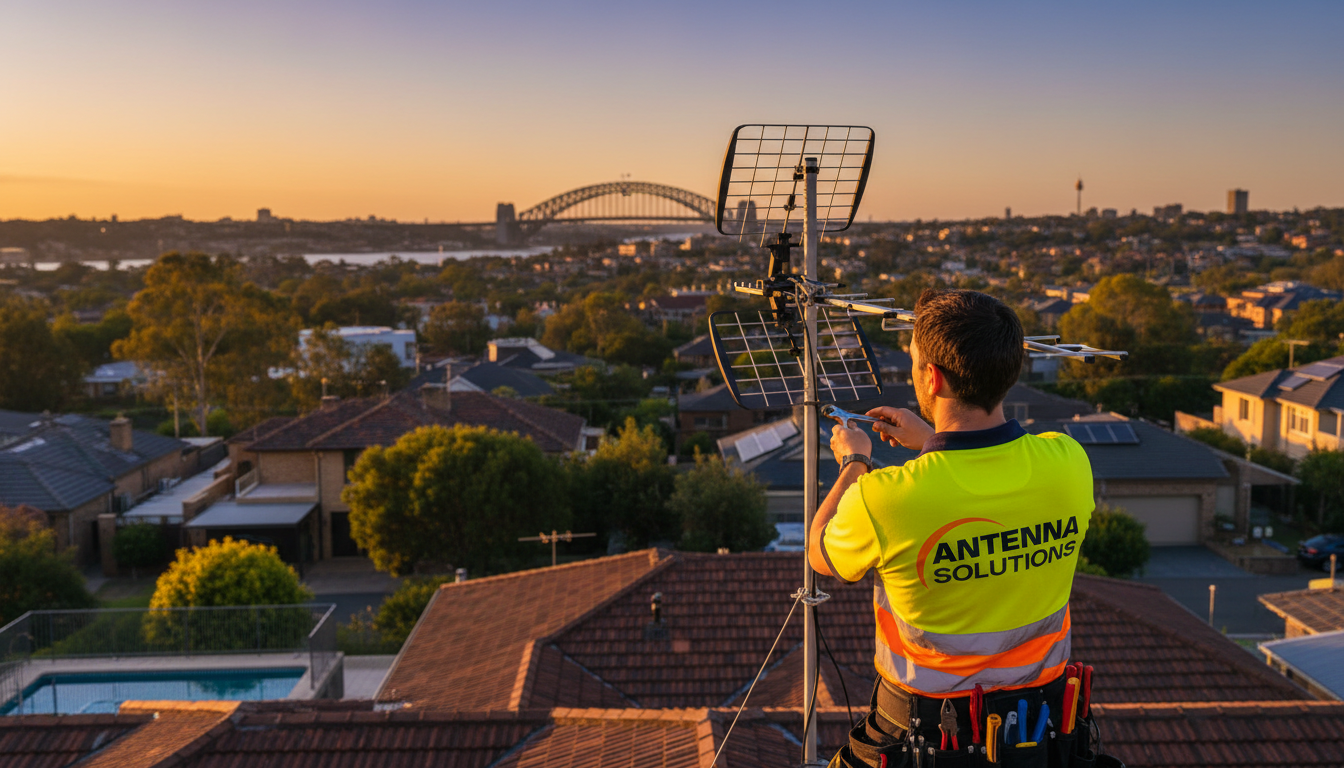
When your television reception deteriorates or fails completely, understanding what professional antenna repairs actually involve helps you make informed decisions about service providers and costs. Searching for antenna repairs near me often returns dozens of results, but not all antenna services deliver the same scope, compliance standards, or technical expertise.
According to the Australian Communications and Media Authority (ACMA), over 13 million Australians access free-to-air television, making antenna maintenance and repair services essential for continued reception quality. If you’ve noticed pixelation, signal dropouts, or complete loss of channels, you may be experiencing one of the 5 signs your TV antenna needs repair that require professional assessment.
This explainer breaks down the actual scope of professional antenna repairs, from signal diagnostics and component replacement to compliance requirements under the Telecommunications Act 1997 (Cth). Understanding these services helps Sydney homeowners and property managers distinguish between qualified ACMA-registered cablers and unqualified operators.
What Professional Antenna Repairs Actually Include
Professional antenna repairs extend well beyond simply adjusting your rooftop antenna. Comprehensive antenna services include signal strength measurement, spectrum analysis, component-level diagnostics, coaxial cable testing, distribution system assessment, and compliance documentation.
Under the Australian Communications and Media Authority (ACMA) Cabling Provider Rules 2014, all work involving antenna systems, coaxial cabling, and signal distribution must be performed by ACMA-registered cablers who hold current Open Cabler Registration. This registration ensures technicians understand signal theory, safety protocols under the Work Health and Safety Act 2011 (NSW), and compliance obligations that protect both homeowners and the broader telecommunications network.
Sydney Cabling has completed over 40,000 antenna installations and repairs across Greater Sydney in 15+ years of service, providing our technicians with extensive experience across diverse signal environments from Bondi to Penrith and Hornsby to Sutherland Shire.
Signal Testing and Diagnostics (dBm Measurement and Spectrum Analysis)
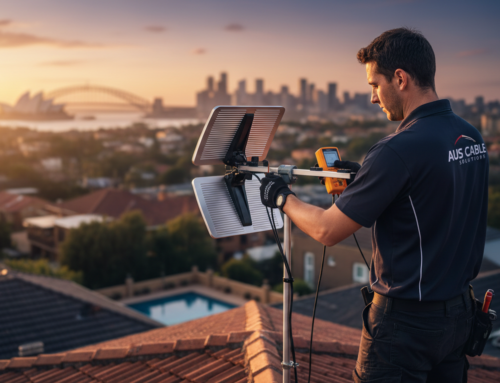
Every professional antenna repair begins with comprehensive signal diagnostics. ACMA-registered cablers use calibrated spectrum analysers and field strength meters to measure signal strength in dBm (decibels relative to one milliwatt) and identify interference sources, multipath reflections, or inadequate signal levels.
A healthy digital television signal in Sydney typically measures between -30 dBm and -60 dBm at the antenna terminals. Signals weaker than -65 dBm usually indicate antenna misalignment, damaged elements, or excessive cable loss. Professional diagnostics also measure Modulation Error Ratio (MER), which quantifies signal quality beyond simple strength measurements. MER values below 20 dB typically result in pixelation or complete signal dropout.
Spectrum analysis identifies specific frequency bands affected by interference, helping technicians distinguish between antenna faults, cable degradation, or external interference from sources like 4G/5G mobile networks or nearby electrical equipment. This diagnostic precision prevents unnecessary component replacement and targets repairs to actual fault points. For detailed guidance on signal issues, refer to our resource on troubleshooting weak TV signals.
Professional antenna repairs include testing at multiple points: at the antenna terminals, at distribution amplifiers or splitters, and at individual outlet points throughout the property. This systematic approach identifies whether signal loss occurs at the antenna, within the distribution system, or at specific outlets. When you contact TV antenna repairs Sydney services, this diagnostic phase should always precede any repair recommendations.
Antenna Component Replacement and Upgrades
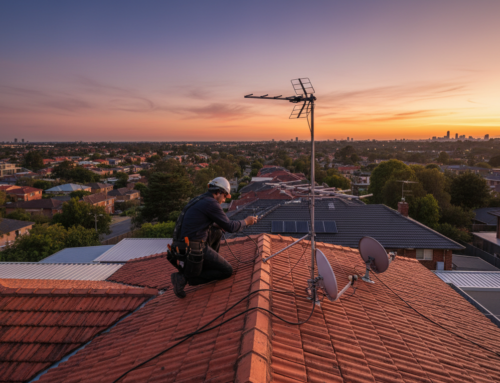
Antenna repairs often involve replacing damaged or corroded components rather than entire antenna assemblies. Professional cablers assess individual elements including UHF directors, reflectors, dipole elements, and mounting hardware to determine which components require replacement.
UHF antennas, which receive digital television signals in Australia, consist of multiple aluminium elements that can corrode, bend, or detach over time. Even minor element damage significantly reduces antenna gain (measured in dBi) and directional reception patterns. Professional repairs restore original antenna specifications by replacing damaged elements with manufacturer-specified components.
For properties receiving signals from multiple transmission towers, antenna repairs may include diplexer replacement or adjustment. Diplexers combine UHF and VHF signals from separate antennas onto a single coaxial cable, and component failure results in complete loss of one signal band. Understanding antenna fundamentals helps property managers recognise when component-level repairs offer better value than complete replacement, as explained in our practical guide to antennas and TV reception.
Satellite dish repairs follow similar diagnostic principles but focus on LNB (Low Noise Block downconverter) functionality, dish alignment, and F-type connector integrity. LNB failure presents as complete signal loss or intermittent reception, while misalignment typically affects specific satellite transponders rather than all channels.
Mounting hardware assessment forms part of comprehensive antenna repairs. Tilt mounts, J-mounts, and chimney brackets deteriorate under Sydney’s coastal conditions, and loose mounting hardware allows wind movement that degrades signal quality. Professional repairs include mounting hardware inspection and replacement where corrosion or mechanical failure compromises antenna stability.
Coaxial Cable Testing and Replacement (RG6 vs RG11)
Coaxial cable degradation causes more reception problems than antenna faults in many Sydney properties. Professional antenna repairs include cable testing using time-domain reflectometry (TDR) to identify cable faults, water ingress, or excessive signal loss over cable runs.
RG6 coaxial cable remains standard for most residential antenna installations with cable runs under 30 metres. This cable type provides adequate shielding and signal loss characteristics (approximately 5-6 dB per 100 metres at UHF frequencies) for typical installations. However, longer cable runs, multiple splitters, or marginal signal areas may require RG11 cable, which offers lower signal loss (approximately 3-4 dB per 100 metres) due to thicker centre conductor and enhanced shielding.
Cable replacement addresses several common failure modes. UV degradation affects external cable runs, causing shielding breakdown and increased susceptibility to interference. Water ingress through damaged cable jackets or poorly sealed F-type connectors corrodes the centre conductor and degrades signal quality progressively. Mechanical damage from roof traffic, branch contact, or animal activity requires cable replacement rather than repair.
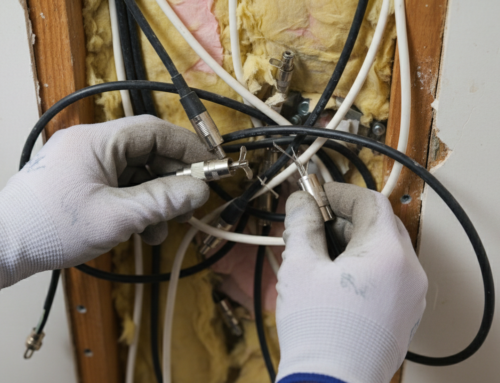
Professional antenna services include F-type connector replacement and proper compression fitting techniques. Poor connector installation creates impedance mismatches that reflect signal energy back toward the antenna, reducing effective signal strength at television outlets. ACMA-registered cablers use calibrated compression tools and verify connector impedance to maintain 75-ohm system specifications throughout the installation.
Distribution Amplifier and Splitter Repairs
Properties with multiple television outlets rely on distribution amplifiers and splitters to maintain adequate signal levels throughout the premises. These components fail more frequently than antennas themselves, and professional antenna repairs include systematic testing of all distribution system components.
Distribution amplifiers (also called masthead amplifiers when mounted at the antenna) boost signal strength to compensate for splitter losses and cable attenuation. Amplifier failure presents as weak signals at all outlets simultaneously, while partial failure may affect specific frequency bands. Professional repairs include power supply testing, amplifier gain verification, and noise figure measurement to ensure amplifiers improve rather than degrade signal quality.
Splitters divide antenna signals to multiple outlets, with each split reducing signal strength by 3-4 dB for two-way splitters and progressively more for higher split counts. Corroded splitter ports, failed internal components, or incorrect splitter specifications cause outlet-specific signal problems. ACMA-registered cablers replace splitters with appropriate specifications for the signal environment and outlet count, ensuring adequate signal levels at all termination points.
Fred, our lead technician at Sydney Cabling, regularly encounters distribution system faults misdiagnosed as antenna problems. Systematic testing from antenna to outlets identifies actual fault locations and prevents unnecessary antenna replacement when distribution component repair resolves reception issues.
Why ACMA Licensing Matters for Antenna Repairs
The Telecommunications Act 1997 (Cth) mandates that all cabling work, including antenna repairs, must be performed by registered cablers to ensure public safety and network integrity. This legal requirement protects homeowners from liability and ensures repairs meet technical standards that prevent interference with telecommunications networks.
ACMA registration requires cablers to demonstrate technical competence, maintain current knowledge of Australian Standards, and carry appropriate insurance coverage. The Australian Communications and Media Authority (ACMA) Cabling Provider Rules 2014 establish specific obligations including compliance certificates, defect rectification, and record-keeping that protect consumers and maintain installation quality.
Unlicensed antenna repairs create several risks. Improper installations may cause interference affecting neighbours’ reception or mobile networks, potentially resulting in ACMA enforcement action and fines. Substandard repairs void equipment warranties and insurance coverage, leaving property owners liable for subsequent damage. Most significantly, roof work by unqualified operators creates serious safety risks under the Work Health and Safety Act 2011 (NSW) and Work Health and Safety Regulation 2017 (NSW).
When searching for antenna repairs near me, verify ACMA registration through the ACMA Cabling Provider Register before engaging any service provider. Our guide on how to choose a reliable antenna technician in Sydney provides detailed verification steps and questions to ask potential service providers.
What Homeowners Can Safely Check Themselves
While antenna repairs require ACMA-registered cablers, homeowners can safely perform several diagnostic checks that help technicians identify problems more quickly and may resolve simple issues without service calls.
Indoor troubleshooting includes checking F-type connector tightness at wall outlets and television inputs. Loose connectors cause intermittent reception and signal dropouts. Homeowners can hand-tighten these connectors without tools, though excessive force may damage connector threads. Television tuner resets and channel rescans resolve issues caused by transmitter changes or software glitches rather than antenna faults.
Testing reception on multiple televisions helps isolate whether problems affect all outlets (indicating antenna or distribution system faults) or single outlets (suggesting localised cable or connector issues). This information helps technicians diagnose problems more efficiently during service calls.
Our simple antenna repairs guide details safe homeowner checks and clearly distinguishes these from work requiring licensed cablers. Never attempt roof access, antenna adjustment, or cable work without ACMA registration and appropriate safety equipment as required under the Work Health and Safety Regulation 2017 (NSW).
Visual inspection from ground level can identify obvious antenna damage including broken elements, displaced mounting hardware, or vegetation contact. However, even visual assessment from roof level requires appropriate fall protection equipment and working-at-heights training mandated by NSW Fair Trading and SafeWork NSW.
Preventative Maintenance Services
Professional antenna services extend beyond reactive repairs to include preventative maintenance that identifies developing problems before they cause reception failure. Regular maintenance proves particularly valuable for strata properties, commercial premises, and coastal locations where environmental exposure accelerates component degradation.
Preventative maintenance includes antenna element inspection for corrosion or mechanical damage, mounting hardware tightness verification, coaxial cable condition assessment, and F-type connector inspection for corrosion or water ingress. These checks identify components approaching end-of-life before complete failure occurs.
Distribution system maintenance includes amplifier performance testing, splitter port inspection, and power supply verification. Amplifiers degrade gradually over time, and periodic testing identifies reduced gain or increased noise figure before signal quality becomes unacceptable. Splitter corrosion develops slowly in coastal environments, and early detection prevents progressive signal degradation.
Signal strength documentation during maintenance visits establishes baseline measurements for future comparison. Progressive signal strength reduction indicates developing antenna misalignment, element damage, or cable degradation requiring attention. The benefits of regular TV antenna maintenance include extended component life, reduced emergency repair costs, and consistent reception quality.
Maintenance schedules vary by location and installation type. Coastal properties benefit from annual inspections due to accelerated corrosion, while inland locations may require inspection only every 2-3 years. Strata properties with multiple dwelling units should implement regular maintenance schedules to prevent reception complaints and identify shared infrastructure problems early.
When to Repair vs Replace Your Antenna System
Professional antenna repairs include honest assessment of whether repair or replacement offers better value and performance. Several factors influence this decision including component age, extent of damage, current antenna specifications, and signal environment changes.
Antenna systems over 15 years old often warrant replacement rather than repair. Older antennas may lack adequate gain for current digital television signal requirements, and accumulated corrosion affects multiple components simultaneously. Complete replacement with modern high-gain antennas often costs only marginally more than extensive repairs while delivering superior performance and warranty coverage.
Extensive storm damage affecting multiple antenna elements, mounting hardware, and coaxial cable typically justifies replacement. Insurance coverage often applies to storm damage, and replacement ensures all components meet current specifications and Australian Standards rather than mixing old and new components with potentially incompatible characteristics.
Signal environment changes may require antenna upgrades beyond simple repairs. New transmission towers, changed transmitter power levels, or increased urban interference sometimes necessitate higher-gain antennas, different antenna types, or relocated mounting positions that exceed repair scope.
Conversely, recent installations with isolated component failures benefit from targeted repairs. Single element damage, failed amplifiers, or localised cable faults in otherwise sound systems warrant repair rather than complete replacement. ACMA-registered cablers provide honest recommendations based on technical assessment rather than maximising service costs.
Sydney Cabling’s up to 20 years warranty on certain parts and labour provides long-term protection for both repairs and replacements, giving property owners confidence in service quality and component longevity. Warranty terms should always be confirmed in writing before work commences, and ensure compliance with NSW Fair Trading requirements for service contracts.
Frequently Asked Questions
Do I need a licensed cabler for antenna repairs in Sydney?
Yes. Under the Australian Communications and Media Authority (ACMA) Cabling Provider Rules 2014, all antenna repairs involving coaxial cabling, roof-mounted equipment, or signal distribution systems must be performed by an ACMA-registered cabler. This ensures compliance with the Telecommunications Act 1997 (Cth) and protects homeowners from liability for network interference, safety violations, and voided insurance coverage. Verify ACMA registration through the ACMA Cabling Provider Register before engaging any antenna service provider.
What signal strength should my TV antenna receive in Sydney?
A healthy digital TV signal in Sydney typically measures between -30 dBm and -60 dBm at the antenna terminals. Professional antenna repairs include spectrum analysis to measure signal strength in dBm and identify interference sources or multipath reflections. Signals weaker than -65 dBm usually require amplification, antenna repositioning, or component replacement to restore reliable reception. ACMA-registered cablers also measure Modulation Error Ratio (MER), with values below 20 dB indicating signal quality problems requiring repair.
How long does a professional antenna repair take?
Most antenna repairs in Sydney take 1-2 hours, including signal diagnostics with spectrum analysers, component replacement, and compliance testing at all outlet points. Complex repairs involving distribution amplifiers, multiple splitters, or extensive coaxial cable replacement may take 2-4 hours depending on the system configuration and property access. Roof work requires additional time for safety equipment setup as mandated by the Work Health and Safety Regulation 2017 (NSW). ACMA-registered cablers provide time estimates after initial diagnostics identify specific repair requirements.
What’s the difference between RG6 and RG11 coaxial cable?
RG6 coaxial cable is standard for most residential antenna installations with runs under 30 metres, providing approximately 5-6 dB signal loss per 100 metres at UHF frequencies. RG11 has lower signal loss over longer distances (approximately 3-4 dB per 100 metres) due to thicker centre conductor and enhanced shielding. Professional antenna repairs assess cable type and recommend upgrades to RG11 when signal loss exceeds acceptable levels for your installation distance, multiple splitters reduce available signal, or marginal signal areas require maximum signal preservation.
Are antenna repairs covered by warranty in Sydney?
Reputable antenna services like Sydney Cabling offer warranties on parts and labour, with up to 20 years coverage on certain components. Always confirm warranty terms in writing before repairs commence, and ensure your technician is ACMA-registered to maintain warranty validity and compliance with NSW Fair Trading requirements. Warranty coverage typically excludes damage from storms, lightning strikes, or subsequent work by unlicensed operators. Keep compliance certificates and service documentation to support warranty claims if future problems develop.
Sydney Cabling has completed over 40,000 antenna installations and repairs across Greater Sydney in 15+ years of service. Our ACMA-registered cablers deliver compliant, warrantied repairs with up to 20 years coverage on certain parts and labour. Contact us today for professional antenna repairs near you.
ACMA licensed. 15+ years experience. Over 40,000 completed jobs across Greater Sydney. Up to 20-year warranty on parts and labour.