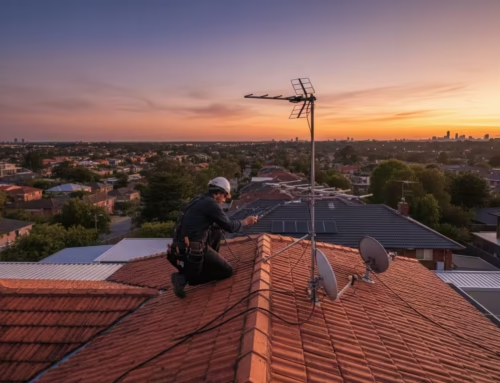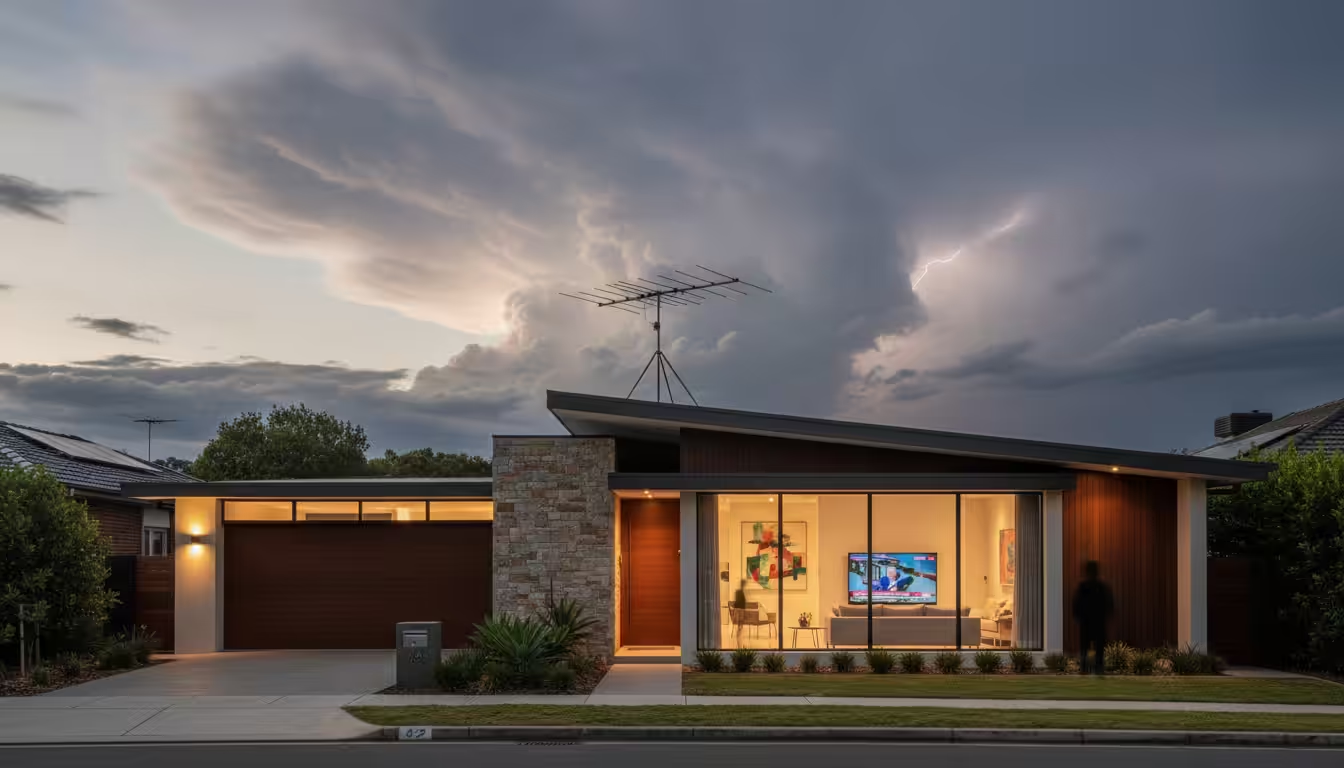
You settle in to watch the evening news, but your TV screen pixelates and freezes. By morning, reception is perfect. A week later, heavy rain rolls across Sydney, and your channels drop out again. If you’ve noticed your antenna signal drops at night or during weather changes, you’re experiencing atmospheric interference—a common frustration for Sydney homeowners that often requires professional diagnosis to boost antenna signal reliability. Understanding why UHF and VHF signals behave differently under varying atmospheric conditions helps you distinguish between temporary environmental interference and equipment failure requiring repair by an ACMA-registered cabler.
Sydney Cabling’s lead technician Fred has diagnosed thousands of weather-related signal complaints across Greater Sydney over 15+ years, and the pattern is clear: what homeowners describe as “bad reception at night” or “signal loss in the rain” usually stems from one of three causes—tropospheric ducting, rain fade, or degraded coaxial cable connections that fail under thermal stress or moisture ingress.
Why TV Signals Weaken at Night: Atmospheric Propagation Explained
Television signals travel as radio frequency waves through the atmosphere, and their propagation characteristics change with temperature, humidity, and air pressure. During daylight hours, solar heating creates turbulent atmospheric mixing that scatters UHF and VHF signals relatively uniformly. After sunset, the atmosphere cools and stabilises into distinct layers—a phenomenon that alters how radio waves refract and reflect between your antenna and the transmitter.
The Australian Communications and Media Authority (ACMA) reports that UHF digital TV signals (channels 6-12 and 28-51) are more susceptible to atmospheric interference than legacy VHF signals due to shorter wavelengths and higher frequency propagation characteristics. This means the same atmospheric conditions that barely affect AM radio can cause significant disruption to your digital TV reception, particularly if your antenna is marginally aligned or your signal strength sits near the minimum threshold for reliable decoding (typically -65 dBm for digital tuners).
Nighttime signal degradation rarely indicates antenna failure. More often, it reveals that your installation lacks sufficient signal margin to compensate for normal atmospheric variation. An ACMA-registered cabler can measure your signal strength in dBm and determine whether antenna reorientation, a distribution amplifier, or upgraded coaxial cable will restore consistent reception regardless of time of day.
Understanding UHF and VHF Signal Propagation in Sydney
Sydney’s free-to-air television services broadcast primarily on UHF frequencies (470-803 MHz) from transmitters at Artarmon, Gore Hill, and Balgowlah Heights. Understanding how antennas work and affect TV reception requires recognising that UHF signals travel in nearly straight lines and are easily blocked by buildings, hills, and foliage, but they’re also more susceptible to atmospheric refraction than lower-frequency VHF signals.
Your antenna’s gain—measured in dBi—determines how effectively it captures these signals. A standard UHF antenna typically provides 10-14 dBi gain, while high-gain models designed for fringe reception areas can deliver 16-20 dBi. However, higher gain also means narrower beam width, making precise alignment critical. A 2-degree misalignment on a high-gain antenna can reduce signal strength by 3-6 dB, enough to cause intermittent dropouts when atmospheric conditions degrade signal quality.
Signal propagation also depends on your location within Greater Sydney. Homes in Sutherland Shire, Northern Beaches, and Western Sydney suburbs often receive signals reflected off buildings or terrain rather than direct line-of-sight paths. These multipath signals arrive at your antenna with slight time delays, creating interference patterns that shift as atmospheric conditions change temperature and humidity gradients throughout the day.
Weather-Related Signal Interference: Rain, Wind, and Temperature Changes
According to the Bureau of Meteorology, Sydney experiences an average of 104 rain days annually, with heavy rainfall events (>25mm) capable of reducing UHF signal strength by 3-5 dB—enough to cause reception failure in marginal signal areas. This phenomenon, called rain fade, occurs because water droplets absorb and scatter radio frequency energy as signals travel between the transmitter and your antenna.
By the Numbers
- STATThe Australian Communications and Media Authority (ACMA) reports that UHF digital TV signals (channels 6-12 and 28-51) are more susceptible to atmospheric interference than legacy VHF signals due to shorter wavelengths and higher frequency propagation characteristics.
- STATAccording to the Bureau of Meteorology, Sydney experiences an average of 104 rain days annually, with heavy rainfall events (>25mm) capable of reducing UHF signal strength by 3-5 dB—enough to cause reception failure in marginal signal areas.
Rain fade affects UHF frequencies more severely than VHF because attenuation increases with frequency. At 600 MHz (typical for Sydney’s UHF channels), heavy rain can attenuate signals by 0.05-0.1 dB per kilometre of path length. For homes 20-30 kilometres from the nearest transmitter, this translates to 1-3 dB loss during storms—marginal in strong signal areas but catastrophic where reception is already borderline.
Wind also degrades reception by physically moving your antenna, changing its alignment to the transmitter. A poorly secured antenna on a corroded or undersized mount can shift several degrees during strong winds, reducing signal strength by 5-10 dB. This is why how weather affects your antenna extends beyond atmospheric interference to include mechanical stress on mounting hardware, coaxial cable connections, and the antenna element itself.
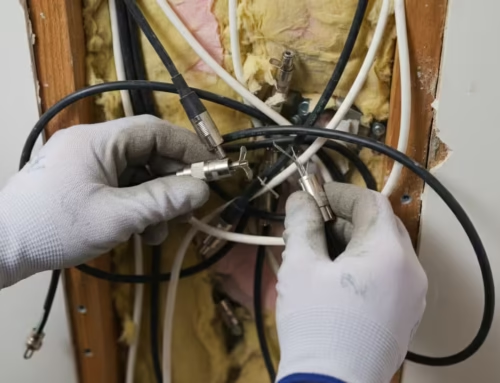
Temperature changes cause thermal expansion and contraction in coaxial cable and connectors. Over time, this cycling loosens F-type connectors, allowing moisture ingress that corrodes the centre conductor and shield. Once corrosion begins, signal loss increases during humid or rainy conditions because water bridges the gap between conductors, creating a partial short circuit that attenuates high-frequency signals.
Tropospheric Ducting and Signal Reflection at Night
Tropospheric ducting occurs when atmospheric temperature inversions create layers that refract radio waves back toward the ground, allowing UHF and VHF signals to travel far beyond their normal range. In Sydney, this phenomenon is most common during autumn and winter nights when clear skies allow rapid surface cooling while upper atmospheric layers remain warm.
When ducting occurs, your antenna may receive signals from distant transmitters—sometimes hundreds of kilometres away—that operate on the same frequencies as your local Sydney channels. These distant signals interfere with the local transmissions your tuner expects, causing pixelation, audio dropouts, or complete loss of picture as the digital tuner struggles to decode two overlapping signals.
Tropospheric ducting is temporary and unpredictable, but if your reception consistently degrades at night, it suggests your antenna may be receiving signals from multiple directions or your signal strength lacks sufficient margin to reject interference. An ACMA-registered cabler can install a higher-gain directional antenna with narrower beam width to focus on your local transmitter while rejecting off-axis signals, or add a distribution amplifier to boost your desired signal above the interference threshold.
Temperature inversions also affect signal reflection off buildings and terrain. During the day, thermal turbulence scatters reflected signals randomly. At night, stable atmospheric layers create more consistent reflection paths, sometimes strengthening multipath interference that causes ghosting or signal cancellation at your antenna. This is particularly problematic in suburbs like Parramatta, Chatswood, and North Sydney where high-rise buildings create complex reflection environments.
How Coaxial Cable Quality Affects Signal Stability (RG6 vs RG11)
Coaxial cable quality directly determines how much signal reaches your television from your antenna. Standard RG6 coaxial cable, commonly used in residential installations, attenuates UHF signals by approximately 6-8 dB per 100 metres at 600 MHz. RG11 cable, with its thicker centre conductor and improved shielding, reduces attenuation to 4-5 dB per 100 metres—a significant advantage for long cable runs or marginal signal areas.
Cable degradation accelerates signal loss. UV exposure breaks down the outer jacket, allowing moisture to penetrate the foam dielectric. Once wet, the dielectric’s insulating properties degrade, increasing signal loss and creating impedance mismatches that reflect signals back toward the antenna rather than delivering them to your tuner. This is why outdoor cable runs must use UV-rated quad-shield RG6 or RG11 cable with compression F-type connectors that create weatherproof seals.
Poor-quality connectors cause more signal loss than the cable itself. Crimp-on F-type connectors, common in DIY installations, create inconsistent contact pressure that loosens over time. Compression connectors, used by licensed cablers, create permanent gas-tight seals that maintain consistent impedance and prevent moisture ingress. The difference can be 1-2 dB per connection—negligible in strong signal areas but critical where every decibel matters.
Under the Telecommunications Act 1997 (Cth), only ACMA-registered cablers can legally install or repair coaxial cable connected to antennas. This requirement exists because improper cable installation creates signal loss, interference, and safety hazards. Sydney Cabling’s technicians use calibrated signal meters to measure dBm levels at the antenna and at each outlet, ensuring cable quality meets Australian standards for digital television reception.
Distribution Amplifiers and Signal Boosters: When They Help
Distribution amplifiers compensate for signal loss caused by cable runs, splitters, and marginal reception areas. A typical masthead amplifier provides 10-20 dBi gain, installed at the antenna to boost signal before cable attenuation occurs. This placement is critical—amplifying a weak signal at the television end also amplifies noise, often worsening reception rather than improving it.
Amplifiers only help when your existing signal quality is adequate but signal strength is insufficient. If your antenna receives a noisy signal due to multipath interference, physical obstruction, or incorrect alignment, amplification magnifies the noise along with the desired signal, reducing your tuner’s ability to decode the digital stream. This is why boost antenna signals with professional equipment requires diagnostic testing before installation—adding an amplifier to a poorly aligned antenna wastes money and may worsen reception.
Distribution amplifiers also serve homes with multiple televisions. Each splitter in your antenna system divides signal power—a two-way splitter reduces signal by 3.5 dB to each output, a four-way splitter by 7 dB. For homes with four or more televisions, a distribution amplifier compensates for splitter loss while maintaining adequate signal levels at each outlet. Licensed cablers calculate total system loss and select amplifiers with appropriate gain to deliver -50 to -40 dBm at each television—the optimal range for digital tuner performance.
Amplifier quality matters. Cheap amplifiers introduce noise and intermodulation distortion that degrades Modulation Error Ratio (MER)—the key metric for digital signal quality. Professional-grade amplifiers used by Sydney Cabling maintain MER above 30 dB, ensuring clean signal amplification that improves reception without introducing artefacts. Over 40,000 completed jobs across Greater Sydney have taught us that proper amplifier selection and placement often makes the difference between reliable reception and ongoing frustration.
How to Boost Antenna Reception During Signal Interference
When atmospheric interference causes signal loss, several professional solutions can restore reliable reception. The appropriate fix depends on whether your problem stems from insufficient signal strength, poor signal quality, or equipment degradation. Understanding how to boost antenna signal in Sydney requires diagnostic testing that only ACMA-registered cablers can legally perform.
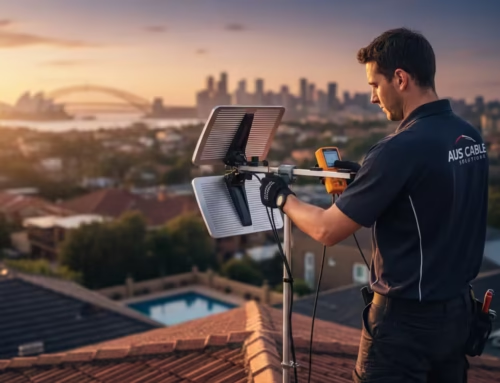
Antenna realignment addresses signal quality issues caused by multipath interference or incorrect orientation. Sydney’s transmitters serve different geographic areas, and many suburbs receive usable signals from multiple towers. If your antenna points toward a distant transmitter when a closer one serves your area, you may experience weather-related dropouts because the longer signal path accumulates more atmospheric attenuation. A licensed cabler uses spectrum analysers to identify the strongest transmitter for your location and realigns your antenna for optimal reception.
Antenna upgrades improve both signal strength and directivity. High-gain UHF antennas with 16-20 dBi gain capture more signal energy while rejecting off-axis interference from distant transmitters. For homes in fringe reception areas like Campbelltown, Penrith, or the Central Coast, upgrading from a standard 10 dBi antenna to a high-gain model can improve signal strength by 6-10 dB—often the difference between pixelated reception and perfect picture quality.
Cable replacement eliminates signal loss from degraded coaxial runs. If your installation uses RG59 cable (common in older homes) or UV-damaged RG6, upgrading to quad-shield RG6 or RG11 with compression connectors can recover 3-8 dB of signal that was being lost to cable attenuation. For detailed diagnostic steps, refer to our guide on troubleshooting weak TV signals to understand what measurements indicate cable problems versus antenna issues.
Important:
When Environmental Interference Indicates Equipment Failure
Temporary signal loss during heavy rain or at night is normal atmospheric behaviour. Persistent problems that worsen over time indicate equipment failure requiring professional repair. Recognising signs your TV antenna needs repair helps you distinguish between weather-related interference you must tolerate and hardware faults you should fix.
Progressive signal degradation suggests corrosion or mechanical damage. If reception quality declines steadily over weeks or months, moisture has likely penetrated cable connections or the antenna’s driven elements have corroded. Aluminium antennas, common in coastal Sydney suburbs, corrode faster in salt air, developing white oxide deposits that increase resistance and reduce signal capture efficiency. Stainless steel or marine-grade antennas resist corrosion but cost more—a worthwhile investment in areas like Manly, Cronulla, or Maroubra where salt spray accelerates deterioration.
Intermittent dropouts that occur regardless of weather indicate loose connections or damaged cable. Thermal cycling causes F-type connectors to loosen, creating intermittent contact that disrupts signal flow. Wind movement can also flex cable at connection points, eventually breaking the centre conductor inside the connector. These faults create symptoms identical to atmospheric interference but occur randomly rather than correlating with specific weather conditions.
Preventative maintenance reduces weather-related damage. The benefits of regular TV antenna maintenance include early detection of corroded connections, loose mounting hardware, and UV-damaged cable before they cause reception failure. Sydney Cabling recommends biennial inspections for coastal installations and every three to five years for inland suburbs, with immediate inspection after severe storms or high winds.
Why ACMA-Registered Cablers Matter for Signal Diagnostics
Diagnosing signal problems requires calibrated test equipment and technical knowledge that only ACMA-registered cablers possess. A spectrum analyser measures signal strength in dBm, identifies interference sources, and evaluates MER to determine whether poor reception stems from insufficient signal, excessive noise, or multipath interference. Consumer-grade signal meters sold at electronics retailers lack the accuracy and functionality needed for proper diagnosis.
ACMA registration requires completion of accredited training in the Telecommunications Act 1997 (Cth), Australian Standards for antenna installation, and safe work practices under the Work Health and Safety Act 2011 (NSW). This training ensures cablers understand signal propagation theory, can interpret technical measurements, and follow safety protocols for working at heights. NSW Fair Trading enforces these requirements to protect consumers from unsafe installations and ensure antenna systems meet performance standards.
Licensed cablers also carry public liability insurance and provide warranties on workmanship—critical protections if installation errors cause property damage or signal problems. Sydney Cabling offers up to 20 years warranty on certain parts and labour, reflecting our confidence in the quality of materials and installation techniques used across more than 40,000 completed jobs throughout Greater Sydney.
Attempting DIY antenna repairs violates the Australian Communications and Media Authority (ACMA) Cabling Provider Rules 2014 and creates safety risks. Roof work requires fall protection equipment and training mandated by the Work Health and Safety Regulation 2017 (NSW). Even ground-level antenna work involves electrical safety considerations—antennas can accumulate static charge or contact overhead power lines during installation, creating electrocution hazards for untrained individuals.
Frequently Asked Questions
Why does my TV signal get worse at night in Sydney?
Nighttime signal degradation often results from tropospheric ducting, where cooler atmospheric layers refract UHF and VHF signals differently than during the day. This can cause distant transmitter signals to interfere with your local Sydney broadcast signals, creating pixelation or dropouts. An ACMA-registered cabler can assess whether a distribution amplifier or antenna reorientation will resolve the issue.
Can rain really affect my digital TV antenna signal?
Yes—heavy rain attenuates UHF signals (typically 3-5 dB loss in severe storms) because water droplets absorb and scatter radio frequency energy between the transmitter and your antenna. If signal loss persists after weather clears, corroded connections or water ingress in coaxial cable may require repair by a licensed cabler under the Australian Communications and Media Authority (ACMA) Cabling Provider Rules 2014.
How can I boost my antenna signal during bad weather?
Installing a masthead amplifier (typically 10-20 dBi gain) at the antenna can compensate for weather-related signal loss, but only if your existing signal strength is adequate—amplifying a weak or noisy signal worsens reception. A licensed cabler will measure signal levels in dBm and determine whether amplification, antenna upgrade, or cable replacement (RG6 to RG11) is appropriate.
Does temperature affect TV antenna reception in Sydney?
Temperature inversions—common in Sydney during autumn and winter mornings—create atmospheric layers that bend UHF signals, sometimes causing distant transmitters to interfere with local channels. This is a temporary atmospheric condition, but if reception problems occur daily, your antenna may need realignment to the correct Sydney transmitter (Artarmon, Gore Hill, or Balgowlah Heights).
Should I replace my antenna if signal drops during weather changes?
Not necessarily—weather-related signal loss often indicates corroded connections, damaged coaxial cable, or inadequate antenna gain rather than antenna failure. Under the Telecommunications Act 1997 (Cth), only ACMA-registered cablers can legally diagnose and repair antenna systems. Sydney Cabling provides free signal assessments to determine whether repair, amplification, or replacement is most cost-effective.
If your TV signal consistently drops at night or during weather changes, Sydney Cabling’s ACMA-registered technicians can diagnose atmospheric interference, test signal strength in dBm, and install distribution amplifiers or upgraded antennas to restore reliable reception. With over 40,000 completed jobs across Greater Sydney and up to 20 years warranty on certain parts and labour, we deliver lasting solutions backed by 15+ years of technical expertise.
ACMA licensed. 15+ years experience. Over 40,000 completed jobs across Greater Sydney. Up to 20-year warranty on parts and labour.